Horror has always been a genre built on taking chances. While major studio productions have the financial muscle, recognizable talent, and marketing power to reach massive audiences, some of the most memorable and culturally influential horror films have emerged from filmmakers working with far fewer resources.
Independent horror has become a creative playground where filmmakers can take unusual ideas, challenge conventions, and build stories around atmosphere, character, and genuine suspense rather than relying solely on expensive production techniques. In many cases, limitations become an advantage.
Freedom to Go Where the Studios Won’t
One of the greatest strengths of independent filmmaking is creative flexibility.
Without the same layers of corporate decision-making, market testing, and franchise considerations found in major studio productions, independent filmmakers can pursue unconventional concepts and darker themes. They can take narrative risks, experiment with structure, embrace unusual visual styles, and create endings that may not fit the expectations of mainstream audiences.
Films such as The Blair Witch Projectand Paranormal Activitydemonstrated how powerful a simple concept can become when filmmakers prioritize immersion and suspense over spectacle.
Their success wasn’t built on enormous production budgets. It was built on making audiences believe what they were watching.
Making More With Less
A limited budget can force filmmakers to become more inventive.
Instead of depending on elaborate visual effects or massive sets, independent horror frequently turns to lighting, sound, silence, isolation, atmosphere, and psychological tension. A hallway can become terrifying. A bedroom can become a nightmare. Sometimes what the audience doesn’t see is far more frightening than what appears on screen.
This approach has helped create some of the genre’s most distinctive films, proving that fear doesn’t necessarily require millions of dollars.
In horror, imagination can be more valuable than spectacle.
The Audience Becomes Part of the Journey
Independent horror also benefits from a unique relationship between filmmakers and their audiences.
Film festivals, conventions, social media, crowdfunding campaigns, and word-of-mouth communities can give independent projects a passionate audience long before a traditional theatrical release.
Fans aren’t simply consumers. They can become advocates.
When viewers discover a horror film through a festival recommendation, a friend’s social-media post, or a filmmaker’s personal interaction with the community, the experience can feel more personal. That connection can transform a small production into a cult phenomenon.
Where the Studio Model Can Struggle
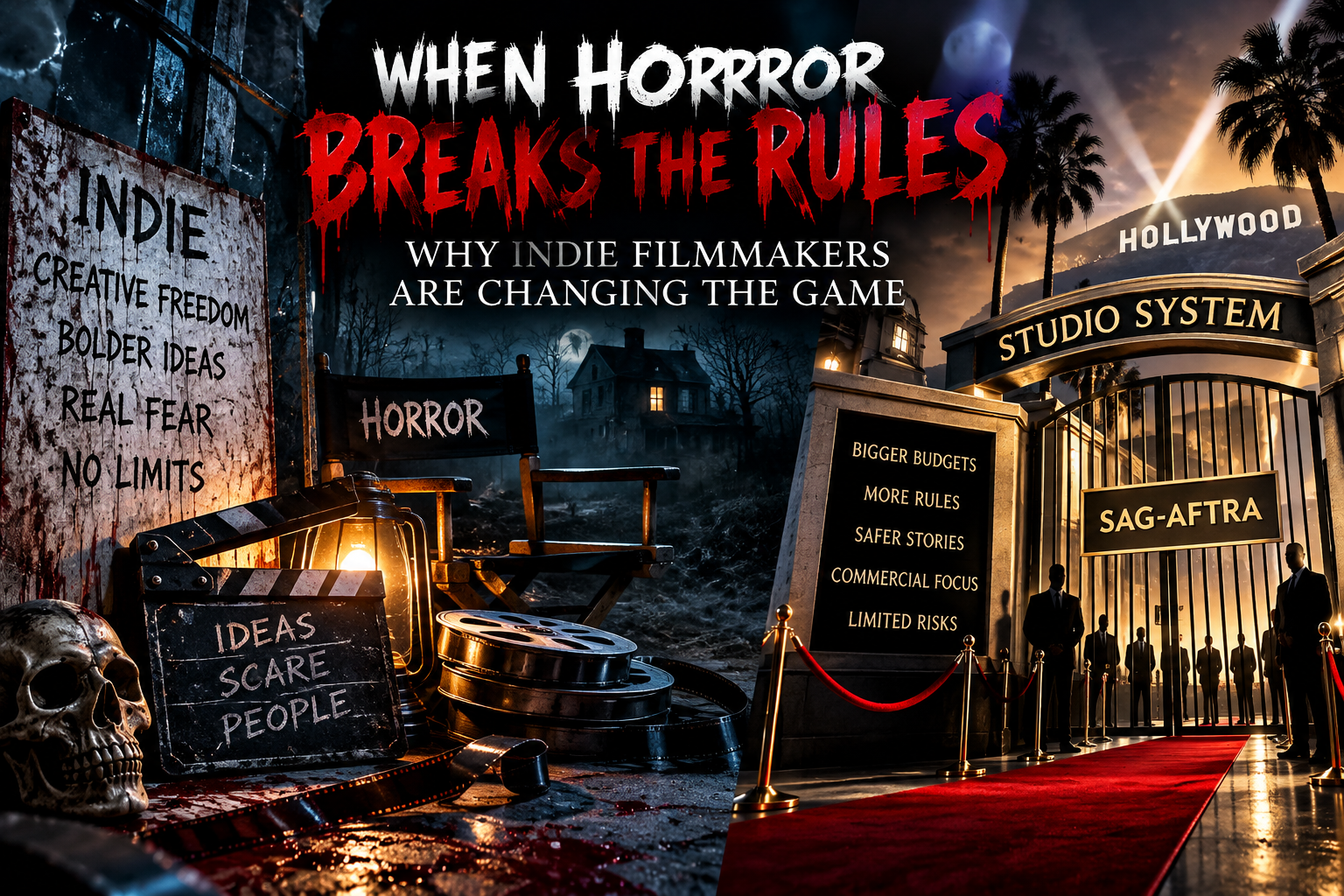
The traditional studio system offers tremendous advantages, including financing, distribution, professional infrastructure, recognizable talent, and sophisticated marketing. But those advantages can also come with creative compromises.
Major productions often have to consider everything from budgets and release strategies to ratings, international markets, franchise potential, and audience expectations.
The result can sometimes be horror that feels familiar rather than revolutionary.
This isn’t necessarily a criticism of SAG-AFTRA or the performers and professionals working under union protections. Those protections are important. The issue is the larger production ecosystem surrounding major studio filmmaking and the number of creative and commercial considerations that can influence a project.
Independent filmmakers often have fewer barriers between the original idea and the finished movie.
When Restrictions Create Innovation
Some of horror’s most creative moments come from filmmakers working around limitations.
A smaller crew may inspire a more intimate visual style. A limited location can create claustrophobia. A lack of special-effects money can encourage practical creativity. A relatively unknown cast can make the story feel more believable.
Rather than asking, “How can we make this bigger?” independent filmmakers often ask, “How can we make this scarier?”
That distinction matters.
Indie Horror Finds Its Champions
The modern horror landscape is filled with examples of independent-minded filmmaking finding enormous audiences.
A24 helped demonstrate that audiences would embrace horror that crossed into psychological drama, arthouse cinema, and social commentary with films such as Hereditary, The Witch, and Midsommar.
Meanwhile, productions such as Terrifier 2demonstrated the extraordinary potential of grassroots horror fandom. Built on a comparatively modest budget, the film generated significant attention through enthusiastic audiences, word-of-mouth promotion, and a passionate fan base.
Festival discoveries can follow a similar path. A film may begin with a relatively small audience at an event such as Sundance, TIFF, or Fantastic Fest before developing a much larger following through critical attention, streaming, theatrical distribution, or social media.
The Future Belongs to the Fearless
The future of horror isn’t necessarily about choosing between independent filmmaking and Hollywood.
It’s about recognizing what each model does best.
Major productions can deliver scale, resources, technical expertise, and extraordinary talent. Independent productions can deliver experimentation, personality, unpredictability, and creative freedom.
And sometimes the most frightening movie is the one nobody expected to become a hit.
The Take
Independent horror continues to thrive because fear doesn’t require a massive budget—it requires imagination.
The filmmakers willing to experiment, take creative risks, embrace unconventional ideas, and trust their audience are often the ones who create something that stays with viewers long after the credits roll.
Hollywood has the resources to build enormous worlds.
But independent horror has something equally powerful: the freedom to break the rules.
And in a genre built around the unexpected, that freedom can be terrifyingly effective.