

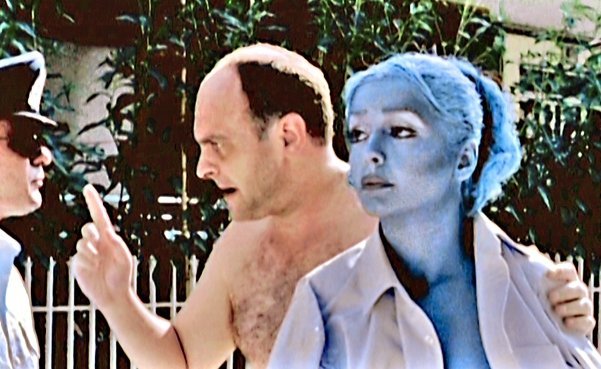
Despina Mirou may be able to make an audience laugh, but there is another side of the Greek-American actress that deserves equal attention: Despina Mirou is a serious dramatic actress with deep theatrical roots.
Long before the impersonations, comedy stages and larger-than-life characters, Mirou built her craft in the theater. Her résumé includes works by some of the most demanding playwrights in history, including Anton Chekhov, Aeschylus, Jean Genet, Oscar Wilde and Nikos Kazantzakis. She has appeared in productions including Uncle Vanya, Oresteia, The Maidsand Salome, developing the kind of classical foundation that can’t be manufactured overnight.
Mirou herself has made her feelings about the stage clear.
“I’m a theatre actress,” she has said, describing classical theater as the foundation of her career and the stage as a continuing exercise that keeps an actor’s talent alive.
That background matters because great dramatic acting isn’t simply about crying on cue or delivering an emotional monologue. It requires control, listening, timing, vulnerability and the ability to disappear inside someone else’s life. Mirou’s greatest strength may be that she refuses to remain one person on screen.
She is a chameleon.

From Cassandra to Sonya
Look at the range of Mirou’s theatrical work and you begin to understand where that versatility comes from. She played Cassandra in Aeschylus’ Oresteia and Sonya in Chekhov’s Uncle Vanya, two characters demanding very different emotional vocabularies. Her stage credits also include The Maids, The Odd Couple and other classical and contemporary productions.
Mirou also participated in an acting masterclass with Al Pacino connected with Salome and studied with John Strasberg, according to her official biography.
Those experiences fit an actress whose performances aren’t built around a single persona. Drama asks an actor to expose something deeper, and Mirou appears most interesting when a role gives her permission to strip away the comic armor and go somewhere darker, quieter or more psychologically complicated.

An Actress Who Refuses to Stay in One Lane
One of the more fascinating things about Mirou’s career is the contradiction at its center.
The woman who can walk onto a comedy stage and transform herself through outrageous characters and celebrity impersonations is also an actress drawn to serious dramatic material. That isn’t a conflict. It’s evidence of range.
Comedy requires precision. Drama requires truth. A performer capable of understanding both has an unusually large toolbox.
Mirou’s screen career has placed her in projects associated with filmmakers including David Cronenberg, Ridley Scott and Paul Haggis, while her credits span television, independent cinema, international productions and theater.
Her current résumé continues to emphasize dramatic work. Her official biography lists roles connected with Hotel Tehran, Ave U and The Ark: An Iron Sky Story, among other projects.
But the titles themselves aren’t what make Mirou compelling.
It’s the transformation.

Drama Reveals a Different Despina Mirou
There are performers whose personalities remain visible in virtually every character they play. Then there are actors who seem to enjoy making themselves difficult to recognize emotionally.
Mirou belongs much closer to the second group.
She can be glamorous without relying on glamour. She can be eccentric without turning a character into a caricature. And when the material becomes serious, she has the theatrical training to pull the performance inward rather than simply making it bigger.
That’s especially important for an actress who has become so accomplished at impersonation. Mirou has portrayed or impersonated famous women including Marilyn Monroe, Elizabeth Taylor, Sophia Loren, Ava Gardner and Joan Crawford. Yet dramatic acting demands something beyond physical resemblance. The challenge isn’t to reproduce an icon’s face, voice or gestures. It’s to find the human being underneath the mythology.
That’s where Mirou’s dramatic instincts become particularly interesting.
A photograph can recreate Marilyn Monroe.
An actress has to find Norma Jeane.
That difference is everything.

The Stage Is Still in Her Blood
Perhaps the best way to understand Despina Mirou is not as a comedian who can perform drama or a dramatic actress who happens to be funny.
She’s a theatrical actress.
The distinction matters.
Theater trained Mirou to take risks. Comedy taught her not to fear an audience. Classical drama gave her language, discipline and emotional structure. Film taught her how to bring all of that intensity down to the movement of an eye or the smallest change in expression.
Her career has moved between Greece, Europe and the United States, but the stage remains the connective tissue running through it.
An earlier profile of Mirou described theater as the backbone of her talent, noting her performances in works by Neil Simon, Chekhov, Aeschylus and Wilde. That description still feels appropriate.
Because beneath all the transformations, comedy, glamour and impersonations is an actress who started with the hardest thing an actor can face:
a stage, an audience and nowhere to hide.
Despina Mirou has proven that she can make people laugh. But when she turns toward drama, another performer emerges—intense, vulnerable, unpredictable and deeply connected to the theatrical tradition that shaped her.
And that may ultimately be the most compelling Despina Mirou of all.