
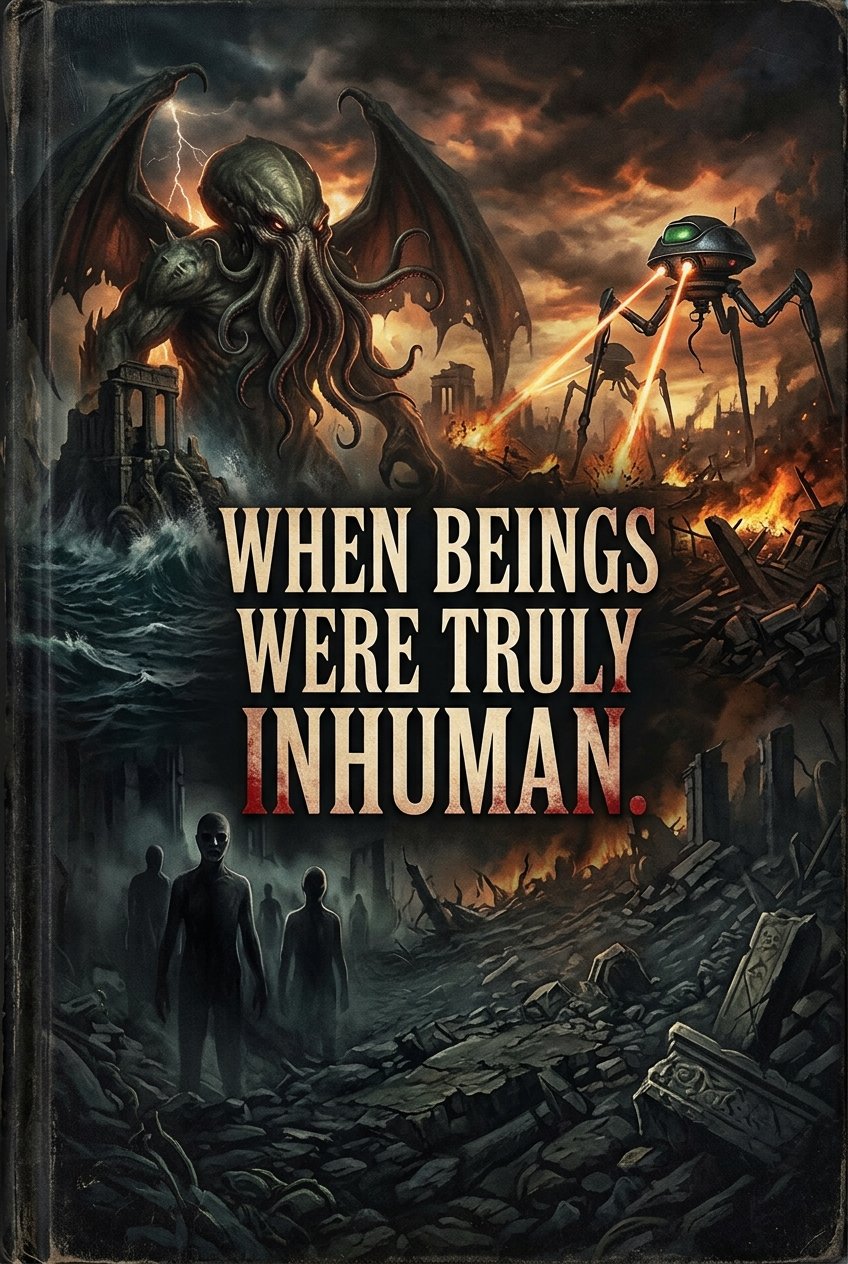
Some of horror’s most frightening creatures are not killers, madmen or ordinary monsters with extraordinary appetites. They are things that exist beyond the boundaries of human understanding, forces that do not share our values, recognize our importance or even acknowledge that humans matter. They cannot be reasoned with in any meaningful sense because their motives, if they have any, belong to a world we were never meant to understand.
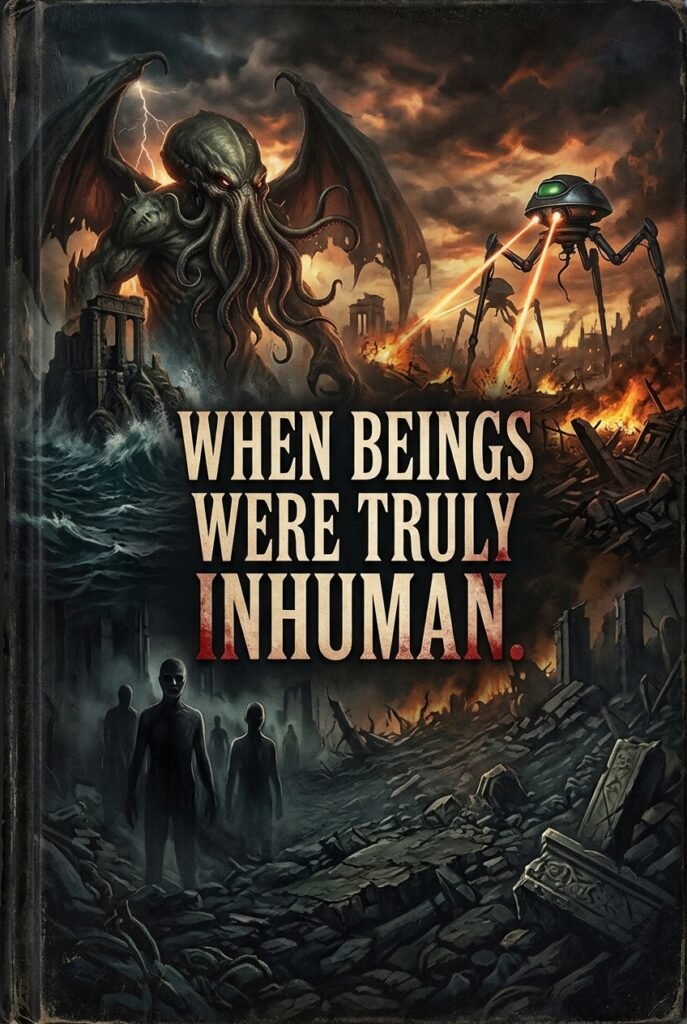
Horror has always drawn on the darkness within human nature but some of its most enduring nightmares emerge when that darkness is replaced by something truly alien. These are the stories in which humanity loses its place at the center of existence, where familiar rules collapse and survival depends on confronting that which is truly terrifying. From the cosmic dread of H.P. Lovecraft to the invading forces imagined by H.G. Wells, these stories remind us that the most terrifying evil may not hate us at all. It may simply have no reason to care whether we live or die.
When Humanity Becomes Insignificant
Few writers understood this better than H.P. Lovecraft, whose work helped establish the foundations of cosmic horror. His creations were not always evil in the conventional sense. Many were simply so ancient, powerful and fundamentally different from humanity that applying human morality to them was pointless. In Lovecraft’s universe, mankind is neither the pinnacle of creation nor the center of some grand cosmic design. We are an insignificant species inhabiting a small corner of reality that existed long before us and will continue long after.
Cthulhu remains the most recognizable embodiment of this idea, although the creature’s significance extends beyond its enormous size and nightmarish appearance. Sleeping beneath the ocean, Cthulhu represents the possibility that forces capable of overwhelming civilization exist beyond our awareness. Humanity’s survival does not necessarily depend on defeating such a being. It may depend on not attracting its attention in the first place. The true horror is not that Cthulhu hates us but that our existence may mean absolutely nothing to it.
Lovecraft’s Color Out Of Space (written-1927, film-2019) takes the idea even further by representing something that resists even the basic categories through which humans understand life. An inexplicable presence contaminated a remote farm, transforming the land and its inhabitants in increasingly disturbing ways. The threat is not a conventional creature with recognizable anatomy or intentions. It is something that arrives from beyond ordinary experience, leaving people to witness the destruction without possessing the language or knowledge to explain it. There is no satisfying conversation to be had with it. No motive to uncover and no guarantee that understanding it would offer any protection.
The Day We Became Prey
H.G. Wells approached the terror of inhuman life from a different direction. His 1898 novel The War Of The Worlds (films 2005 and 2025) imagined Earth invaded by Martians whose technological superiority turns humanity’s confidence into helplessness. The invaders are intelligent but their intelligence does not make them compassionate or interested in human affairs. People become prey, obstacles and expendable inhabitants of a world the Martians intend to conquer.
The most disturbing aspect of Wells’ invasion is the indifference behind it. The Martians do not recognize humanity as an equal opponent. They show no interest in our history, our achievements or our pleas for mercy. We are simply in their way. Wells understood that the greatest humiliation might not be defeat itself but discovering that the enemy does not consider us important enough to hate. The same species that had conquered continents, hunted animals to extinction and reshaped the natural world suddenly finds itself reduced prey.

The reversal is what gives The War Of The Worlds its lasting power. The Martians do not need to be evil by human standards. We have spent centuries imagining ourselves as the dominant force in creation but Wells asks what happens when something arrives that sees us as nothing more than another resource to be consumed. For once humanity is not the hunter. It is the thing being hunted.
The Face Of Something Else
Philip Kaufman’s Invasion Of The Body Snatchers (1978) explores the loss of humanity through a deceptively simple premise. Mysterious alien organisms begin reproducing humans as they sleep, creating duplicates that look and behave like people they replace. At first, the changes seem almost impossible to identify. Familiar faces remain familiar, voices sound the same and everyday routines continue. Yet something essential has disappeared.
The film’s horror comes from the possibility that humanity can be erased without changing the outward appearance. The pod people do not need monstrous faces or grotesque bodies. They walk through the streets, go to work and occupy the spaces left behind by those that have been replaced. What separates them from the people they imitate is not something visible. It’s that their emotional connections have vanished, leaving behind an unsettling imitation of human life.

Unlike a conventional invasion story, the film makes resistance almost impossible to distinguish from paranoia. Someone who suspects their loved one has been replaced may be dismissed as unstable, while the growing number of duplicates makes genuine human interaction dangerous. The threat does not simply kill its victims. It takes their place. There is no need for the invaders to hate humanity. They are simply carrying out a process of replacement and mankind is the thing being displaced. The bleakest possibility is that the end of the human world could arrive without its buildings falling or streets emptying. Everything might look exactly the same.
A Hunger Without Hatred
In The Blob (original 1958, remake 1988), inhuman terror takes a more immediate, physical form. The creature is an expanding mass that consumes living things, grows stronger and continues to spread as people struggle to understand what they are facing. It has no recognizable personality, no grievance to avenge and no moral compass that might explain its actions. It consumes because that’s what it does.
The creature is frightening precisely because of its simplicity. There is no elaborate scheme to uncover, no grand plan. The Blob does not need to be cruel to be lethal. Its existence alone turns ordinary spaces into places of danger, making everyone feel frighteningly vulnerable.

Like Lovecraft’s cosmic entities and Wells’ invading Martians, the creature represents the threat that cannot be reasoned with or persuaded. Humanity encounters something that does not share its need for limitations and discovers that its usual methods of dealing with danger may be pointless. The creature does not need to understand us to kill us.
A World That Does Not Need Us
Modern horror continues to explore the fear of the truly alien. Alex Garland’s Annihilation (2018) offers a particularly unsettling example. At the center of the film is the Shimmer, an expanding phenomenon that transforms the landscape and everything living in its boundary. Plants, animals and human beings are altered in ways science cannot explain. The deeper the characters venture into it, the less certain they become of what they are encountering. There is no clear enemy to confront and no recognizable intelligence to reason with.
The Shimmer does not behave like an invading army or a predator pursuing prey. It changes the world around it, seemingly without regard to the creatures caught within it. Humanity is left trying to interpret a process that may have no connection to human thought or emotion. The threat is not necessarily something that wants to destroy us but that something entirely foreign can transform our existence without ever considering the consequences.

Perhaps that is what makes truly inhuman horror so effective. It strips away the comforting belief that everything in existence must have a purpose we can understand or a place within our world. We are accustomed to seeing ourselves as the center of creation but there is no guarantee that the universe shares that view. Somewhere beyond the limits of our understanding, something may exist that does not know we are here and may never notice when we are gone.