
A look at the unforgettable characters who changed horror—and why we keep coming back for more.
Some horror characters only need a silhouette to make your skin crawl.
A man in a hockey mask standing at the edge of the woods. A figure in a pale mask watching from across the street. A vampire emerging from the shadows. A razor-fingered glove scraping across metal.
You know who they are before they say a word. In some cases, they never say anything at all.
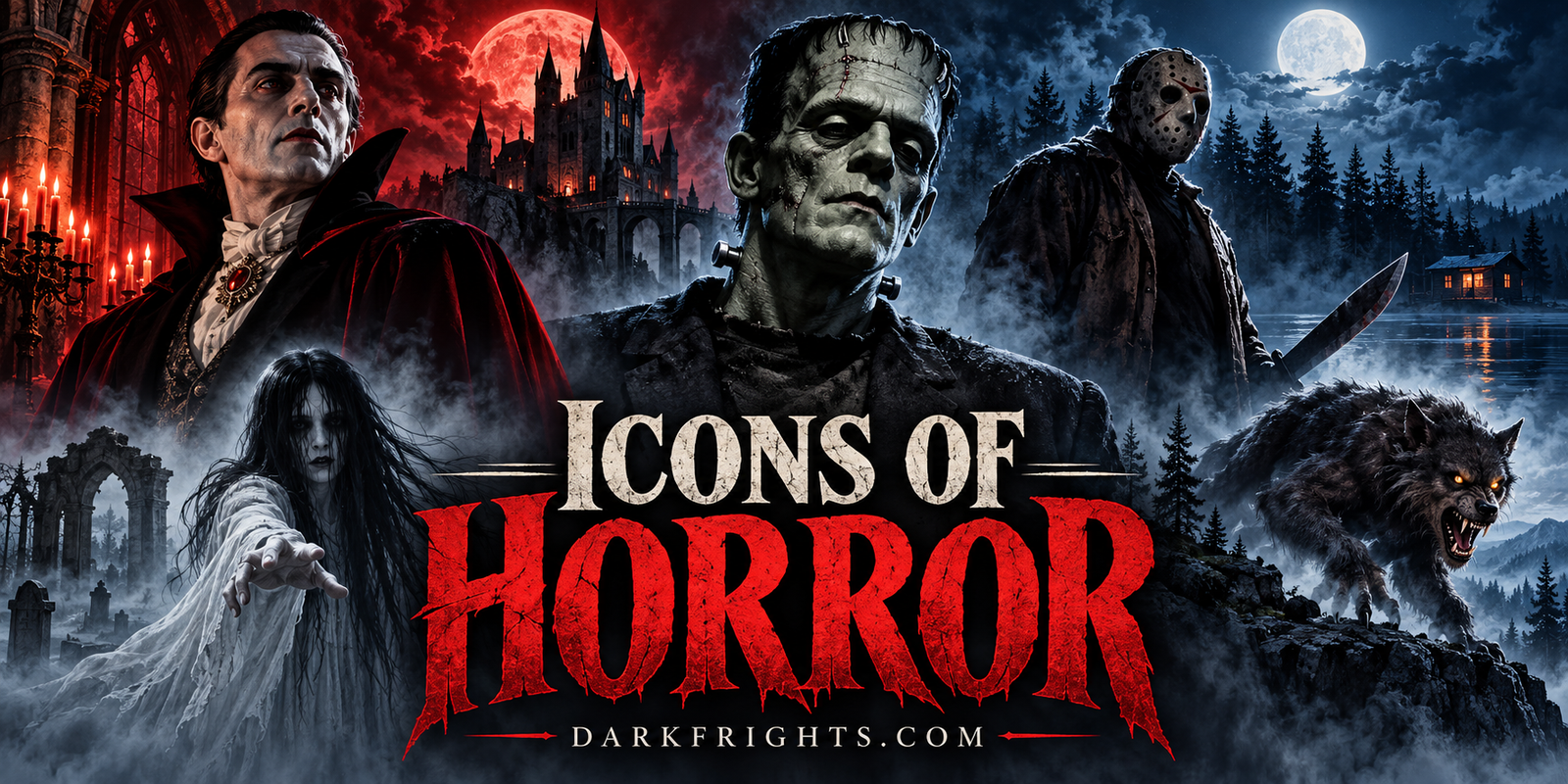
These are the icons of horror: the monsters, killers and supernatural beings who have outlived their original stories to become part of popular culture. They’ve frightened generations, inspired countless imitators, and somehow managed to make us cheer when they return.
So what makes a horror character an icon? A memorable look helps. So does a great movie. But the ones who endure give us something more: a fear we recognize, even when the nightmare itself is impossible.
Dracula: The Vampire Who Never Stays Buried
Before slashers chased teenagers through the woods, Count Dracula was already showing the world how seductive a monster could be.
Bram Stoker introduced Dracula in his 1897 novel, but the count’s screen life helped turn him into one of horror’s most recognizable figures. Bela Lugosi’s performance in the 1931 film gave audiences an elegant, hypnotic vampire whose influence can still be seen today. Christopher Lee later brought a more ferocious presence to the role in Hammer’s films.
Dracula is frightening because he crosses boundaries. He invades homes, enters bedrooms, and turns desire into danger. He can be charming one moment and monstrous the next. That tension has kept vampires alive in popular culture for well over a century.
And no matter how many times Dracula meets his end, horror fans know better than to believe he’s gone for good.
Frankenstein’s Monster: Horror’s Most Misunderstood Creature
Mary Shelley’s Frankenstein gave the world a creature brought to life through human ambition—and then left to face a world that feared him.
Boris Karloff’s portrayal in the 1931 film gave the monster his enduring screen image: the heavy brow, the scars, the awkward movements and the unmistakable silhouette. But what makes the creature so powerful is what lies beneath that frightening appearance.
He didn’t ask to be created. He struggles to understand a world that often responds to him with cruelty. He can be dangerous, but he can also be lonely, curious and heartbreaking.
That’s the brilliance of Frankenstein’s monster. We fear him, but we also feel for him. More than once, the people chasing him seem more monstrous than the creature himself.
The Wolf Man: The Monster Within
Werewolves tap into a fear that feels uncomfortably personal: What if the thing you’re afraid of is inside you?
Lon Chaney Jr.’s Larry Talbot in The Wolf Man helped give audiences one of cinema’s most sympathetic monsters. Talbot isn’t simply a creature stalking victims under the moon. He’s a man cursed to become something he can’t control.
That struggle is at the heart of the werewolf’s appeal. Vampires may choose their victims and slashers may pursue them relentlessly, but the werewolf often becomes the very thing he fears.
Add a full moon, a transformation, and a howl in the distance, and you have a horror image that never seems to lose its bite.
Michael Myers: The Shape of Evil
In John Carpenter’s Halloween, Michael Myers doesn’t need a complicated speech or a theatrical personality. He just watches.
Then he follows.
Then he gets closer.
That blank mask gives audiences almost nothing to read. There’s no expression, no visible emotion, and often no clear sign of what he’s thinking. The result is deeply unsettling: Michael feels less like an ordinary killer and more like a force that has decided to walk into a quiet neighborhood.
What makes him especially frightening is how little he seems to need in order to create terror. A glimpse behind a hedge or a figure standing in the background can be enough.
Michael Myers reminds us that sometimes the scariest thing in a horror movie is the moment before anything happens.
Jason Voorhees: The Legend of Crystal Lake
If Michael Myers made suburban streets terrifying, Jason Voorhees made summer camp a place many horror fans would rather avoid.
The towering figure associated with the Friday the 13th franchise became one of the genre’s most recognizable villains, thanks in large part to his hockey mask and imposing presence. But Jason didn’t begin his screen career wearing that famous mask—it arrived later in the series, becoming a defining part of his look.
Jason is a horror icon built for the campfire story. He’s the figure you imagine moving through the trees when the woods suddenly go quiet. He’s relentless, nearly impossible to stop, and closely tied to a place that seems to hold onto its own dark history.
For generations of fans, a hockey mask is all it takes to bring Crystal Lake to mind.
Freddy Krueger: The Nightmare You Can’t Escape
Most horror villains wait for you in a house, a forest, or a dark alley. Freddy Krueger comes after you when you fall asleep.
That’s what made A Nightmare on Elm Street such a wickedly effective idea. Everyone has to sleep. There’s no locking the door against a killer who can enter your dreams.
With his burned face, striped sweater, fedora and bladed glove, Freddy is instantly recognizable. Robert Englund also gave him a personality unlike many of horror’s silent killers: Freddy could be cruel, theatrical, and darkly funny.
But beneath the one-liners is a terrifying thought. In a dream, the rules of the real world don’t apply. The hallway can stretch, the floor can swallow you, and the monster can appear anywhere.
Freddy turned bedtime into dangerous territory—and made audiences wonder if closing their eyes was such a good idea.
Leatherface: Terror Behind the Mask
Leatherface brought a raw, disturbing energy to horror with The Texas Chain Saw Massacre.
His mask and chainsaw made him immediately recognizable, but his surroundings are just as important. The house, the isolated road, and the unsettling family at the center of the film create a world that feels overheated, chaotic and dangerously unpredictable.
Leatherface isn’t a polished movie villain delivering clever speeches. He’s frightening partly because he feels frantic and difficult to anticipate. Once the chainsaw starts, there’s a sense that anything could happen—and very little time to get away.
His impact can still be felt in horror films that send unsuspecting travelers into places where help is far away and the locals are anything but welcoming.
Chucky: Your New Best Friend
A towering killer is scary. A doll that smiles at you from across the room? That’s a different kind of nightmare.
Chucky, the pint-sized menace of the Child’s Play franchise, takes something associated with childhood and turns it into a foul-mouthed threat. His small size makes him easy to underestimate—and that’s a mistake.
With his overalls, bright hair, mischievous grin and murderous attitude, Chucky has managed to be frightening and entertaining at the same time. He’s proof that a horror icon doesn’t have to be silent, enormous, or lurking in the shadows.
Sometimes he’s sitting right there on the shelf.
Ghostface: The Voice on the Phone
When Ghostface asks, “What’s your favorite scary movie?” it’s probably time to hang up.
The masked killer of Scream arrived with a sharp awareness of horror movies and the rules audiences thought they knew. That famous mask and dark robe made Ghostface instantly recognizable, while the voice on the phone gave the killer a way to get inside a victim’s head before ever stepping into the room.
One of the cleverest things about Ghostface is that the identity behind the mask can change. The costume becomes a shared symbol, and the question of who’s wearing it keeps audiences guessing.
Ghostface helped bring a new generation into the slasher conversation—and gave horror fans a reason to be a little suspicious whenever the phone rings.
Pennywise: Fear With a Smile
Clowns are supposed to make people laugh. Pennywise has other plans.
The terrifying figure from Stephen King’s It preys on children and takes advantage of their fears. The clown is only one form of a much older evil, but it’s the one audiences can’t seem to forget.
Tim Curry’s performance in the 1990 television adaptation and Bill Skarsgård’s interpretation in the later films gave audiences two memorable versions of the character. Both understood something essential: Pennywise can look playful for a moment, but there’s always something horribly wrong beneath the smile.
And after Pennywise, a red balloon floating by itself doesn’t feel nearly as innocent.
The Icons Who Keep Fighting Back
Horror icons aren’t all monsters and killers. Some of the genre’s most memorable characters are the people who survive them.
Laurie Strode, played by Jamie Lee Curtis in Halloween, became one of horror’s defining heroines. Her intelligence, determination and willingness to fight back have kept audiences invested across generations of the franchise.
Ellen Ripley, played by Sigourney Weaver in Alien, faced a creature that seemed almost impossible to defeat. Ripley’s courage helped make her one of the most enduring characters in science fiction and horror.
And Ash Williams, played by Bruce Campbell in the Evil Dead films, brought a different kind of energy to the battle against evil: equal parts determination, chaos and outrageous humor.
These characters give audiences someone to root for when the darkness closes in. They remind us that survival can be just as memorable as the monster.
Why We Keep Inviting Them Back
Horror icons change with the times, but the fears behind them are often familiar.
Dracula makes us question what happens when danger is charming. Frankenstein’s monster asks who the real monster is. Werewolves bring out fears of losing control. Slashers turn familiar places—homes, camps, neighborhoods—into hunting grounds. Freddy makes sleep itself feel dangerous.
And yet we keep watching.
Maybe it’s because a good horror movie lets us face fear from a safe distance. Maybe it’s because these characters are so imaginative that we can’t look away. Or maybe horror fans simply enjoy spending time with a great monster—even when that monster is trying to kill everyone on screen.
Whatever the reason, the icons of horror have earned their place in our nightmares. They’ve become the faces on our posters, the costumes at Halloween parties, and the characters we introduce to the next generation of fans.
And if horror has taught us anything, it’s this:
Just because the movie ends doesn’t mean the monster is gone.
Who’s your favorite horror icon? Are you loyal to the classic monsters, a fan of the slashers, or always cheering for the hero who fights back? Let us know—and keep exploring the darker side of entertainment at DarkFrights.com.