

Forget masked killers and haunted houses. A new breed of horror is turning old videotapes, television static, emergency broadcasts, and distorted human faces into some of the most disturbing entertainment imaginable.
There was a time when the most frightening thing on television was the horror movie playing after midnight. Today, the television itself might be the monster.
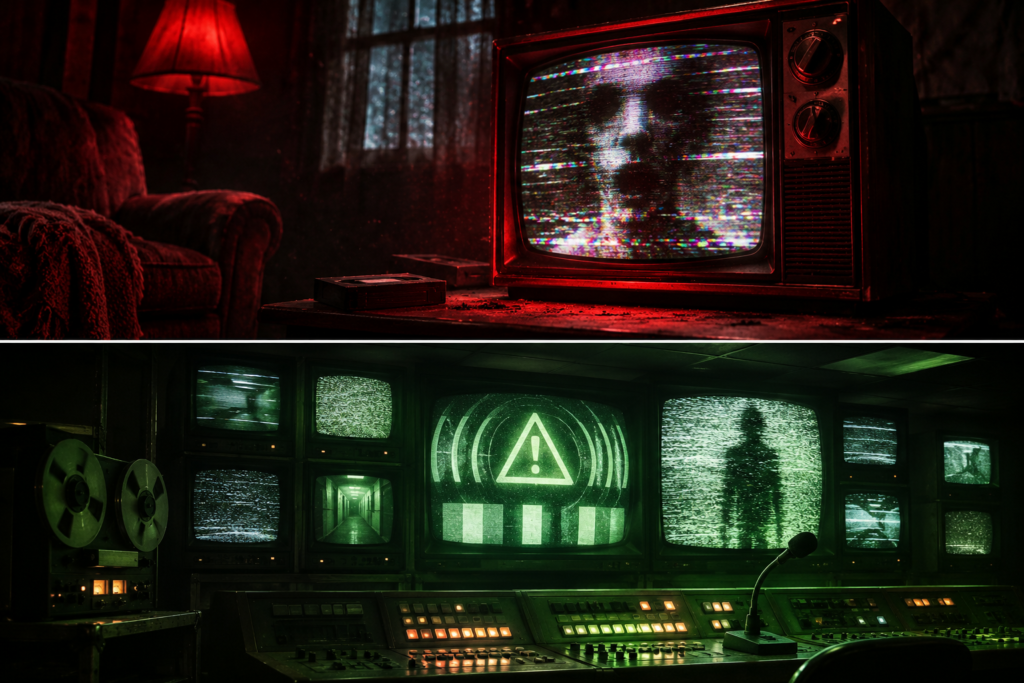
Imagine sitting alone in your living room when an emergency broadcast interrupts your favorite program. The screen flickers. A mechanical voice delivers a warning that makes absolutely no sense. A human face appears, smiling just a little too widely, staring directly into the camera.
Then the broadcast tells you not to look behind you.
Welcome to the disturbing world of analog horror, a genre that has transformed the familiar sights and sounds of outdated technology into a terrifying new language of fear.
And perhaps the most unsettling thing about it is how little it takes to scare you.
When Television Becomes the Enemy
Analog horror takes its inspiration from the technology of previous generations: VHS tapes, grainy instructional films, public-access television, emergency alert systems, and the eerie advertisements that once filled late-night broadcasting.
But instead of offering harmless nostalgia, these recordings suggest that something has gone terribly wrong.
A cheerful educational video might contain an impossible creature. A government safety announcement might warn viewers about people who look human but aren’t. A family recording might reveal an unfamiliar figure standing motionless in the background.
The effect is remarkably powerful because these images resemble something real. They don’t announce themselves as elaborate Hollywood productions.
They look like evidence.
Unlike traditional horror movies, which often rely on elaborate special effects, analog horror invites the audience to fill in the blanks. The creature is rarely shown clearly. The danger is never completely explained. And the people responsible for the broadcasts often seem to know considerably more than they’re willing to reveal.
That uncertainty is precisely what makes the experience so effective.
The Nightmares That Changed Internet Horror
Some of the genre’s most influential creations began as independent projects released online.
Local 58, created by Kris Straub, helped establish the modern analog horror format through fictional television broadcasts that slowly descend into cosmic nightmare. Ordinary programming becomes a delivery system for increasingly disturbing information.
The Mandela Catalogue, created by Alex Kister, introduces terrifying entities known as Alternates, mysterious beings capable of imitating human appearances. The series explores a particularly intimate fear: what happens when the person standing in front of you looks familiar, but something about them is profoundly wrong?
Then there’s Gemini Home Entertainment, created by Remy Abode, which uses the appearance of vintage educational videos and nature documentaries to reveal a deeply unsettling world of strange organisms and cosmic threats.
These productions demonstrate that enormous budgets aren’t necessary to create unforgettable horror. Sometimes a distorted face, an ominous message, and a few seconds of silence are more disturbing than a multimillion-dollar monster.
Their influence can be seen across internet horror culture, where creators increasingly experiment with fragmented storytelling, mysterious recordings, and fictional worlds that audiences must piece together themselves.
Hollywood Discovers the Fear of the Unknown
The popularity of internet-born horror has also helped inspire a new generation of filmmakers.
One notable example is filmmaker Kane Parsons, whose eerie The Backrooms concept transformed seemingly endless, empty rooms into a nightmare of isolation and uncertainty.
While the Backrooms phenomenon is more accurately described as liminal-space and found-footage horror than strictly analog horror, it shares many of the same principles: uncertainty, atmosphere, disturbing imagery, and the suggestion that reality is considerably more fragile than we believe.
The movement also creates an interesting opportunity for independent filmmakers.
Horror has always been one of cinema’s most accessible genres because creativity can matter more than financial resources. Analog horror takes that advantage even further. A convincing story might be created with a camera, a carefully designed location, believable performances, and a genuinely disturbing idea.
The challenge isn’t simply frightening the audience. It’s convincing viewers that they’ve stumbled upon something they were never supposed to see.
Why Our Brains Can’t Look Away
Perhaps the real genius of analog horror lies in its manipulation of trust.
For decades, emergency broadcasts represented authority. Educational films represented knowledge. Television news represented information about the outside world.
Analog horror corrupts these familiar institutions.
Suddenly, the reassuring voice of a broadcaster becomes threatening. The educational video becomes a warning. The television, which has always connected us to the world, becomes a doorway into something incomprehensible.
There’s also the strange power of damaged images.
A heavily distorted face is unsettling because the human brain instinctively attempts to recognize it. When the features don’t quite align with what we expect, the result can feel profoundly unnatural.
The genre doesn’t always need to show us a monster. Sometimes it only needs to convince us that something is watching from the other side of the screen.
The Future of Horror Might Look Like the Past
With digital filmmaking becoming increasingly sophisticated, it’s ironic that some of the most memorable horror experiences deliberately resemble technology from decades ago.
But perhaps that’s exactly why the genre works.
Audiences have become accustomed to spectacular computer-generated monsters, elaborate action sequences, and increasingly expensive cinematic universes. Analog horror strips away those distractions and returns to one of horror’s oldest principles.
What we imagine is often more frightening than what we actually see.
The next generation of nightmare-makers may not need a massive production company, a recognizable movie star, or an elaborate creature created by a visual-effects studio.
They may only need a television, a mysterious recording, and a warning that arrives a few seconds too late.
Because the most terrifying message isn’t necessarily the one telling you that something terrible is coming.
It’s the one telling you that it’s already inside your house.
And whatever you do, don’t change the channel.