
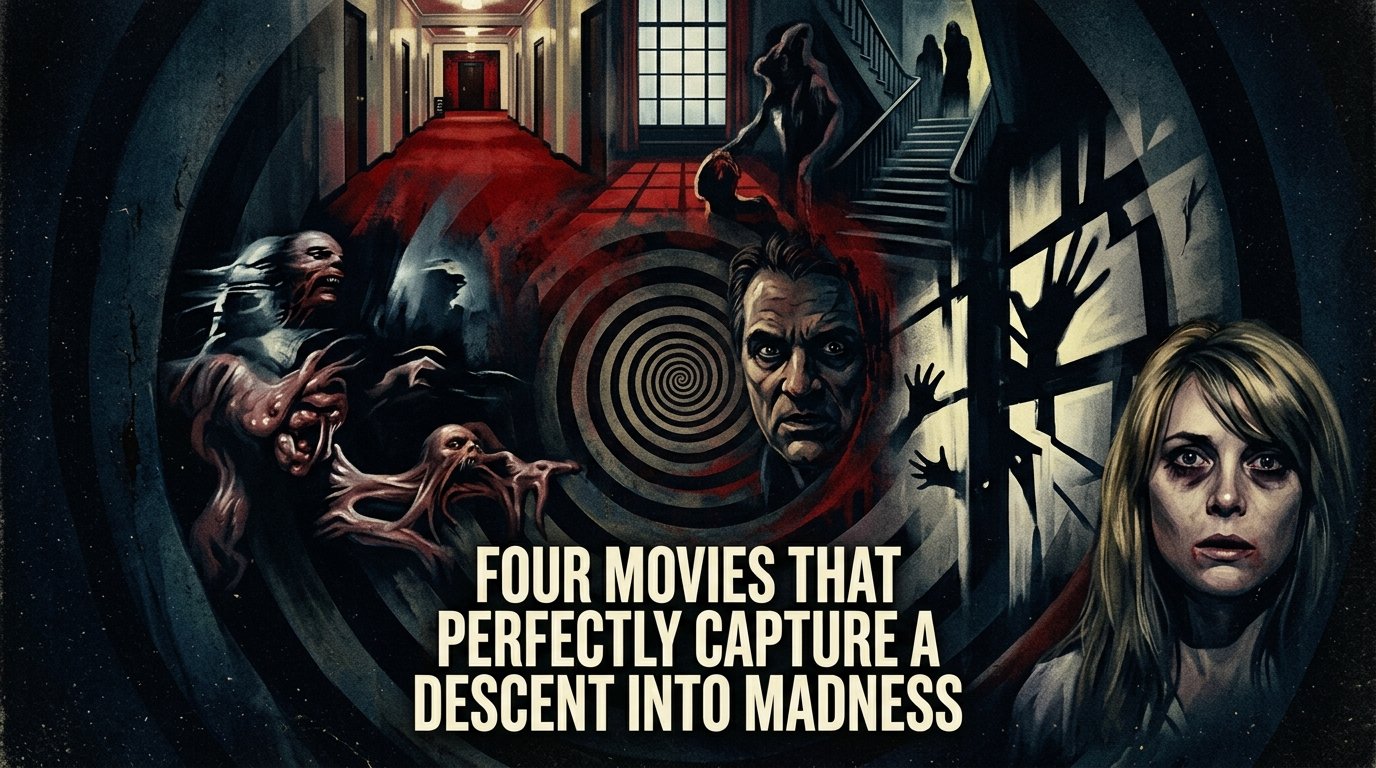
The most frightening of stories are not always about what is lurking in the shadows. Sometimes the true terror comes from watching someone lose their grip on reality. A person who can no longer trust their own thoughts, memories or perceptions can be far more unsettling than any creature or masked killer. Madness is terrifying because it turns the familiar into something dangerous.
The best psychological films don’t simply show a character going insane, they take the audience along for the journey. As the protagonist’s world begins to fracture, viewers are forced to question what is real and what is simply a fractured mind trying to make sense of the impossible. The result is the type of horror that stays with you long after the credits roll.

Throughout the history of horror, filmmakers have explored madness through isolation, trauma, obsession and supernatural forces. These four films stand among the best examples of characters pushed to the edge, proving that sometimes the most terrifying monster is the one waiting inside the human mind.
The Shining (1980)
Stanley Kubrick’s The Shining remains one of the greatest portrayals of a descent into madness ever filmed. The story follows Jack Torrance, a writer who accepts a job as the winter caretaker of the isolated Overlook Hotel, hoping the quiet surroundings will help him finish his novel, Jack instead finds himself trapped in a place where isolation, frustration and the hotel’s dark history begin to take control.

What makes Jack’s breakdown so disturbing is how slowly it happens. He doesn’t begin the film as a monster but as his anger and resentment grow, the audience watches him transform into someone increasingly unpredictable. At the same time, the ghosts of the Overlook Hotel begin drawing him deeper and deeper into the hotel’s darkness, exploiting his weaknesses and feeding his growing rage. His son Danny’s “shine” allows him to see the evil that Jack cannot or refuses to recognize. Danny is left stuck between the spirits haunting the hotel and his father slowly turning on his family. Whether the hotel is causing Jack’s madness or simply revealing what was already there is one of horror’s greatest unanswered questions.
The brilliance of The Shining is that its true horror isn’t just the ghosts haunting the Overlook, it’s watching a man lose himself. The endless isolation, the pressure of failure and the influence of the hotel create the perfect storm for Jack’s unraveling. Decades later, the film remains a masterpiece because it understands that madness rarely appears all at once. It creeps in slowly until the person experiencing it may not even realize they have been changed.
Jacob’s Ladder (1990)
Adrian Lyne’s Jacob’s Ladder takes a very different path into madness, beginning with the psychological scars of war but eventually revealing something far more disturbing. Tim Robbins plays Jacob Singer, a Vietnam veteran whose life begins to fracture beneath the weight of memories he cannot fully understand. Strange visions, grotesque figures and flashes from the past invade his everyday life. It leaves him and the audience increasingly unsure whether he is suffering trauma, losing his mind or experiencing something that should not be possible.
The film’s brilliance lies in making Jacob’s fractured perception feel completely real. Lyne fills the screen with monstrous images, twitching faces and encounters that feel more like a nightmare than reality. Jacob experiences them with genuine terror and confusion. The audience is trapped inside of his mind and forced to question what is real and what is not. Madness isn’t simply happening to Jacob, it becomes the language through which the story is told.

Beneath all the disturbing imagery Jacob’s Ladder is ultimately a tragic story about guilt, memory and acceptance. As Jacob moves deeper into his nightmare, he is unknowingly approaching the truth. He is actually dying from wounds he suffered in combat in Vietnam. Much of what we have witnessed has been unfolding in the final moments of his consciousness. The visions, the memories, the terrifying images become less about a man losing his mind and more about a dying man struggling to let go. When Jacob finally does, the nightmare ends and the film’s horror gives way to something unexpectedly heartbreaking.
In The Mouth Of Madness (1994)
John Carpenter’s In The Mouth Of Madness takes the descent into madness somewhere far more terrifying than the human mind – reality itself. Sam Neill stars as insurance investigator John Trent, who is sent to find missing horror novelist Sutter Cane after his books begin to make readers act strangely. What begins as a straightforward investigation gradually pulls Trent into a world where the impossible becomes ordinary and the boundaries between fiction and reality begin to disappear.
The film’s greatest strength is the way it slowly strips away Trent’s ability to trust what he sees. Strange towns, impossible events and people that seem to know things they shouldn’t, all create an atmosphere where nothing feels stable. Carpenter blends psychological horror with Lovecraftian cosmic terror, suggesting that madness may not be something inside Trent’s head at all. Perhaps he is simply one of the few people left who can see what the world is becoming.

By the time the audience realizes what is happening, there is no comforting escape from it. The horror isn’t simply that he is losing his mind, it’s that his mind may be the only thing standing between him and an unbearable truth. In The Mouth Of Madness turns the idea of madness inside out. It asks whether insanity is really madness if the nightmare you’re seeing is real. It’s one of Carpenter’s most inventive films and one of horror’s best examples of reality itself becoming the monster.
Repulsion (1965)
Roman Polanski’s Repulsion takes the descent into madness and makes it intensely personal. Catherine Deneuve stars as Carol, a young woman whose discomfort with intimacy and growing withdrawal become increasingly severe when she is left alone in her London apartment. What begins as uneasiness slowly develops into paranoia and terrifying hallucinations, as the world outside becomes something Carol increasingly cannot tolerate.
The brilliance of Repulsion is that Polanski traps us inside Carol’s deteriorating perception without ever explaining exactly what is happening to her. The apartment seems to change around her, cracks spread across walls and ordinary spaces become threatening and distorted. Deneuve’s performance is remarkably restrained, making Carol’s eventual breakdown even more disturbing because we can see the fear building beneath her otherwise quiet exterior.

Unlike some of the other films on this list, Repulsion doesn’t need a supernatural explanation for its horrors. There is no ghost to blame and no cosmic force manipulating Carol. The terror comes entirely from watching her mind retreat farther from reality until the apartment becomes a reflection of her fractured psyche. More than sixty years later, Repulsion remains a landmark of horror because it demonstrates how frightening madness can be when there is nothing external to blame.
When The Mind Becomes The Monster
Whether it’s a haunted hotel, the lingering effects of war, reality that has begun to unravel or a mind slowly turning against itself, these films prove that madness can be one of horror’s most powerful weapons. They don’t simply frighten us with what their characters see; they make us question what we would believe if our minds could not be trusted.
And perhaps that is what makes a descent into madness terrifying. You can run from a monster, escape a haunted house or lock a door against a killer. But when the thing you’re fighting is inside your own head, there may be nowhere left to hide.