
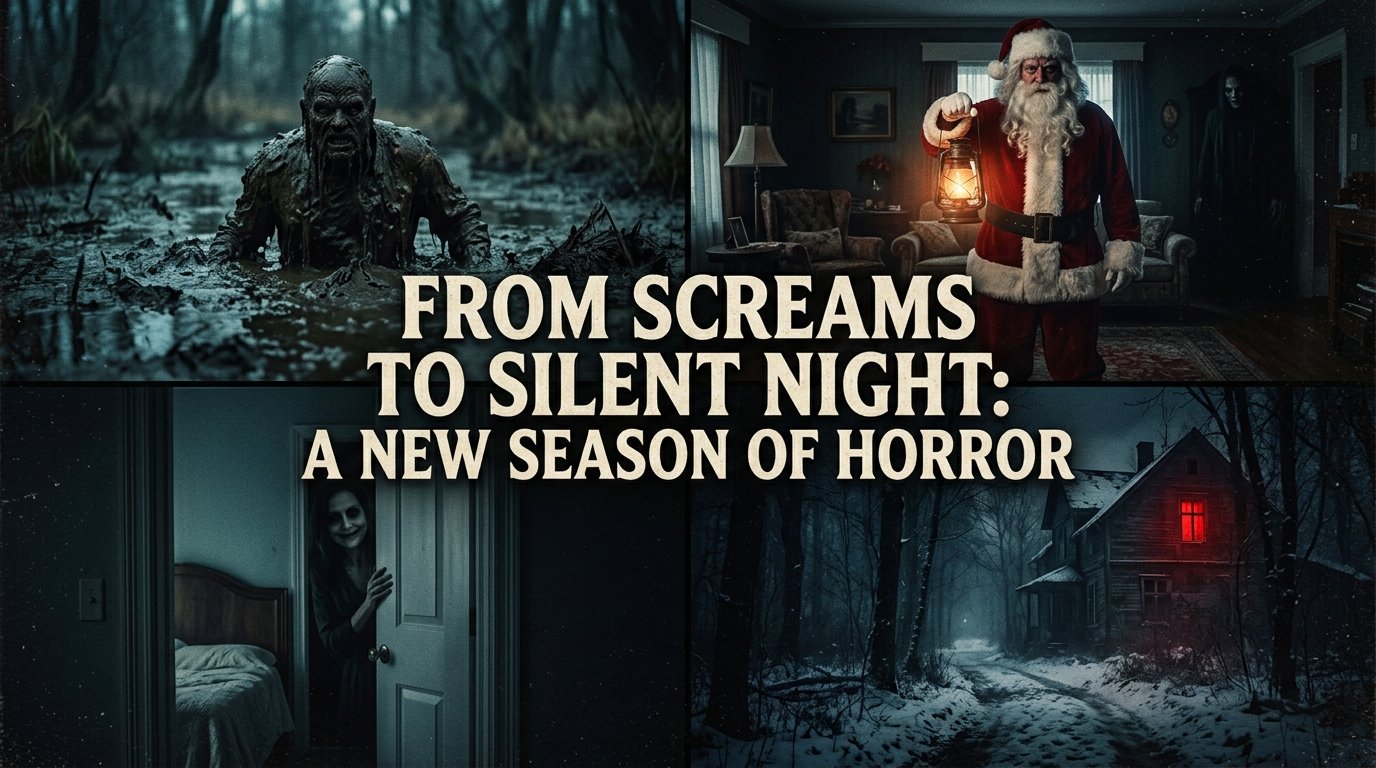
Horror has always had a complicated relationship with the calendar. Halloween may be its most obvious holiday but the genre has never really belonged to October. Ghost stories have been told by fires, monsters have stalked snowy landscapes and some of the darkest tales ever written have arrived wrapped in Christmas imagery. This year, that relationship feels particularly apparent. The upcoming horror slate isn’t simply offering another collection of films designed to fill theaters Halloween weekend. Instead the genre seems to be stretching onward, bringing together body horror, gothic nightmares, ancient folklore, supernatural horror and some decidedly dark takes on Christmas.

What makes the coming months interesting isn’t necessarily the number of movies coming out but the variety of fear they bring with them. Familiar monsters are being pulled from the shadows and given new interpretations, while filmmakers are continuing to discover that the most effective horror can come from things we already know. Our bodies, our homes, our traditions and even the stories we had heard as children can all become frightening when something familiar is slightly wrong. That is where most of the upcoming season’s horror seems to be living.
The Monsters We Can’t Escape
There are few forms of horror as personal as body horror because there is no distance between the audience and the thing being threatened. A haunted house can be escaped, in theory. A monster can be outrun. The human body offers no such luxury. We are trapped inside of it every moment of our lives, which makes the possibility of losing control over it particularly disturbing.
That fear remains at the heart of Clayface, arriving in October. The character has existed for decades as a comic book villain but his shapeshifting ability carries the potential for something far more disturbing. Body horror isn’t about the blood and transformation, although it is cool to watch. It is about identity and the fear that the person looking back at you in the mirror may no longer be somebody you recognize.

That is what makes the genre so effective. We know our bodies will change as we age but we still expect it to be ours. Horror takes that certainty away. It asks what happens when the body begins changing without permission. When our physical identity becomes unstable or when becoming something monstrous is no longer something happening to somebody else.
Clayface isn’t the only film exploring familiar fears in unfamiliar ways. It’s a good example of how horror continues to find new territory in something as ordinary as the human body. The monsters don’t always have to come from somewhere outside of us. Sometimes the most frightening possibility is that we cannot escape the invader already living with us.
Old Fears, New Nightmares
While some horror looks to the future, another part of the genre looks backward. Gothic and folkloric horror have survived because the past offers something that past horror struggles to create: a world where mystery can remain mystery.
That atmosphere is at the heart of Victorian Psycho which arrives in November. Set in nineteenth century England, starring Maika Monroe and Thomas McKenzie, the film takes place in the type of rigid, isolated world where appearances matter and secrets have plenty of places to hide. Gothic horror has always understood that a beautiful setting can be every bit as threatening as a dark one. A grand house can become frightening, not because it looks abandoned but because everything inside of it looks pristine and preserved while something underneath remains permanently wrong.

The same fascination with old fears continues with Robert Eggers’ Werwulf which brings the werewolf back to its folklore roots. Set in medieval England, the film arrives on Christmas Day, an unusual release date for a dark werewolf story. But it is one that fits surprisingly well with the atmosphere of the season.
These films demonstrate why filmmakers continue to return to these stories. We may no longer live in the world that created the original legends but we still understand the fear. Sometimes the oldest monsters only need to be placed in the right darkness to become scary again.
There’s Something Wrong With Christmas
Christmas should be one of the most least frightening times of the year. It is associated with warmth, family, childhood memories and brightly decorated homes. That is exactly why horror keeps finding ways to ruin it.
Christmas horror works because it corrupts something sacred. The holiday is built around expectations: families should be together, people should be happy, homes should feel welcoming. Put something sinister into that mix and the contrast does much of the work.
It is also worth remembering that Christmas and ghost stories have been connected for a very long time. A Christmas Carol (1843, Charles Dickens) is essentially a supernatural Christmas story that has been softened by generations of adaptations. Dickens filled it with ghosts, death, graves and warnings from beyond the grave. This year, Ebenezer: A Christmas Carol, directed by Ti West and starring Johnny Depp as Scrooge and Ian McKellen as Marley, has the opportunity to bring the darkness back to the surface.

Other upcoming films take Christmas horror into a different direction. Violent Night 2 continues the bloody interpretation of the Viking Santa Claus established by its predecessor. While Christmas At The Kringles turn excessive holiday cheer into something considerably more sinister.
Halloween may be the obvious holiday for horror, but Christmas has always had its own darkness waiting and brewing beneath the surface.
What Happens When The Monster Comes Home
Some of the most effective horror doesn’t need an ancient castle or an isolated forest. Sometimes all it needs is your everyday, average home.
This is where Other Mommy, directed by Rob Savage and starring Jessica Chastain, comes in. Based on Josh Malerman’s novel, the film centers on a child who encounters a frightening presence that takes the form of her mother. The premise taps into one of horror’s oldest fears: what happens when something familiar becomes just slightly wrong?
Home is supposed to be the place where we feel safest. We know it sounds, its rooms and the people inside of it. We lock the doors at night because we believe those walls will protect us from the outside world. Supernatural horror becomes particularly effective when that barrier is broken.
Children make that fear even more powerful because horror has always played with the idea that they may see things that adults cannot. A child says there is something in their bedroom and it gets dismissed as an overactive imagination. A strange figure appears in the hallway and someone assumes it’s just a shadow. The audience, meanwhile, is left wondering if the child was the only person paying attention.

That kind of intimate horror is always a little more unsettling than a threat capable of destroying the world. A creature doesn’t need to end civilization to be scary, it only needs inside of the house.
And that might be the common thread running through the upcoming season. Horror doesn’t necessarily need new monsters. It needs ways of making us afraid of things we thought we understood.
Our bodies. Our history. Our traditions. Our homes.
Halloween may be the king of the horror holiday season but it no longer has to mark the end. As the leaves disappear and the snow begins to fall, horror is finding new spaces to hide and some of them are much closer than we think. The screams may eventually give way to Christmas carols but that doesn’t mean the darkness has gone anywhere.
It simply changed its scenery.