

Hell is one of the most familiar images in horror. We picture endless flames, rivers of fire, grotesque demons and tortured souls screaming in agony. It is an image that has been repeated so often in literature, art and cinema that few people question where it actually came from. But the history of Hell is considerably more complicated than the popular imagination suggests. Some of its earlier descriptions are far less familiar and some of the ideas surrounding damnation are considerably more frightening than the traditional image of a fiery underworld.
For centuries, humanity has tried to imagine what waits beyond death. Religious texts, medieval writers and eventually horror filmmakers have all contributed to that picture. But what if the Hell we have come to recognize isn’t nearly as frightening as the one we have yet to imagine?
The Making Of Hell
The familiar image of Hell as an underground kingdom ruled by a horned devil did not come from a single biblical description. It developed over centuries through religious interpretation, literature and folklore. The Old Testament refers to Sheol, generally understood as the realm of the dead, while the New Testament uses words like Hades and Gehennawhen discussing death and judgment. Revelation introduces another disturbing vision of Hell, a lake of fire.
Much of the imagery that shaped the popular imagination came later. Dante Alighieri’s Inferno (published 1472) gave readers a vivid journey through the circles of Hell, each reserved for particular sins and punishments. Medieval artists expanded on these visions, filling their depictions with demons, monstrous creatures and elaborate scenes of torment. Over time, these interpretations became so familiar that they began to overshadow the older, less defined descriptions.
And that leaves an unsettling question: what if Hell is not a place of fire and brimstone but something far worse?
Beyond The Gates
Lucio Fulci’s The Beyond imagines Hell as something that has broken through into our world. Beneath an old Louisiana hotel lies one of seven gateways to the underworld and as the barrier weakens, the living begin to encounter things that should have never crossed over. Fulci’s vision is chaotic and grotesque, presenting Hell not as a kingdom with rules but as an ancient force that cannot be understood or contained.
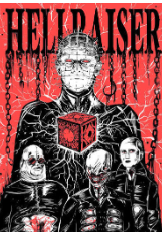
Clive Barker’s Hellraiser (published 1986, movie 1987) offers a different kind of nightmare. Its Cenobites are not traditional devils and their realm is not simply a pit of fire. They exist beyond ordinary human ideas of pleasure and pain, where suffering becomes an experience that the human mind cannot comprehend. Both films move away from the familiar image of Hell as a palace where demons punish sinners. Instead they suggest something far more disturbing, a reality governed by forces that have little regard for human understanding.
Somewhere Beyond Our Understanding
Some of the most unsettling images of Hell take us far beyond the traditional underworld, suggesting that damnation may exist somewhere outside the boundaries of our reality. In Event Horizon (1997), a spacecraft disappears through a black hole and returns carrying something terrible from the dimension it encountered. The film never fully explains what lies on the other side but the suffering left behind suggests a place where madness and pain have become the natural order of existence, a Hell. A similar cosmic dread runs through The Void (2016), where an ordinary hospital becomes the center of an encounter with something ancient and incomprehensible. As the world outside collapses into something monstrous, the characters find themselves caught between reality. They face forces that seem to have no place in the human world.
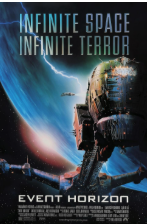
Neither film offers the comfort of a familiar Hell ruled by demons or governed by recognizable laws. Instead, they suggest that something far more frightening may exist beyond our understanding. A place where it does not need to punish us because its very nature is a nightmare. Perhaps Hell isn’t waiting beneath the earth or beyond the grave. Perhaps it is someplace else entirely and humanity has simply been fortunate enough not to find it.
The Real Horror Of Eternity
Perhaps the greatest horror of Hell has very little to do with fire or physical torment. It is thought of as eternity itself. Imagine knowing every moment of suffering will be followed by another, with no possibility of relief and no possibility of escape. There is no final breath, no awakening from the nightmare and no end to the passage of time.
In some interpretations of damnation, the deepest punishment is separation from God, the permanent loss of everything that gives existence meaning. That is a frightening prospect, not because of what may be waiting in the darkness, but perhaps the most frightening question is simpler: what happens when there is no hope left.