

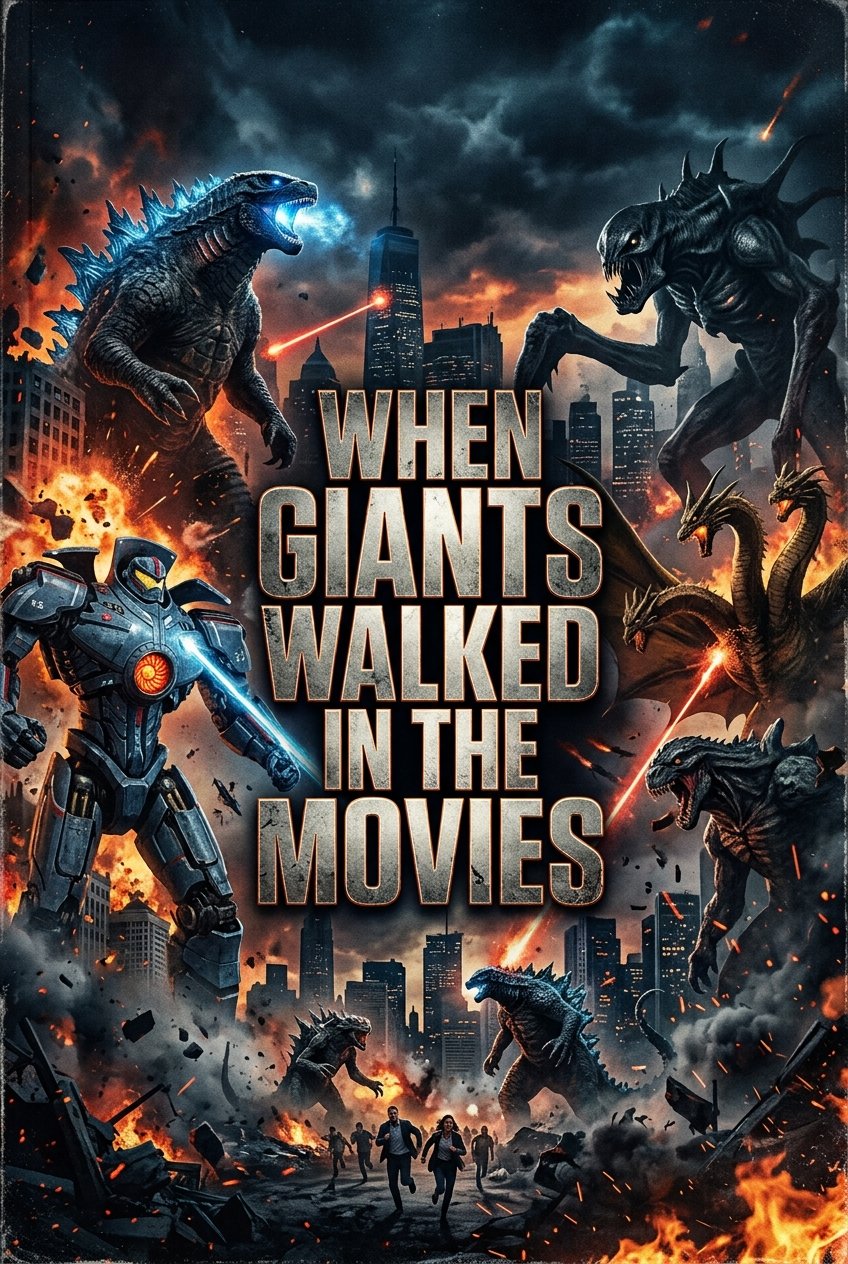
There are few things more unsettling than realizing something enormous is moving toward you and knowing there was nowhere to hide. A strange shape appears on the horizon, rising above the trees and buildings and at first the mind struggles to understand what it is seeing. Then the shape moves and the truth becomes impossible to ignore. It is alive, impossibly large and whatever stands between it and its destination may not survive the encounter. This is the basic fear at the heart of Kaiju horror, a genre built around creatures so enormous that humanity’s usual defenses suddenly seem very small and ineffective.
The fascination with giant monsters did not start in Japan. American audiences had already been introduced to one of cinema’s most famous creatures when King Kong climbed the Empire State Building in 1933. Kong was frightening because of his size and strength but there was something else that made him memorable. He was a creature that could be feared and pitied at the same time. An animal taken from his home, captured, put on display and ultimately destroyed by the very people who had brought him to civilization. His story helped establish an important idea that would continue through the Kaiju genre: sometimes the monster isn’t the villain at all. Sometimes humanity creates the circumstances that bring the monster to our doorstep.
It would be Japan, however, that would turn the giant monster into an entire cinematic tradition. Over the decades, Kaiju films would produce creatures that were terrifying, ridiculous, tragic, heroic, bizarre and sometimes all of those things all at once. Some became household names, while others disappeared into the enormous shadow cast by one particular who first emerged from the sea in 1954.
The King Of The Monsters
When Godzilla appeared in theaters, he was not simply just another giant creature designed to knock over buildings. The original 1954 film gave the monster a weight that went far beyond his physical size. Godzilla was born from the fear surrounding nuclear weapons and the devastation they inflicted on Japan. His arrival was treated less like the appearance of a costumed monster and more like a catastrophe that humanity had brought upon themselves. The destruction of Tokyo was frightening because it represented something people had already experienced with Nagasaki and Hiroshima. Cities could be destroyed. Lives could be lost in enormous numbers and technological advances could have consequences that could not be undone.
Godzilla’s power came from the fact that he could be understood in several different ways. He was a monster, certainly, but he was also a warning, a living consequence of humanity’s relationship with nuclear power. As the films changed, so did he. The grim creature of the original movie eventually became more sympathetic, then heroic and in some films almost a protector of humanity. He fought other monsters, battled aliens, survived increasingly ridiculous situations and somehow remained recognizable through all of it.
That may be why Godzilla has survived for more than seven decades while so many other movie monsters have faded away. He is capable of being reinvented because he can represent what filmmakers need him to represent. Nuclear fear, environmental destruction, military power or the consequence of human arrogance. Godzilla can carry all of it.
He is no longer a monster from a 1954 Japanese film. He has become the face of the Kaiju itself.
The Monsters That Followed
Godzilla may rule the kingdom but he does not rule it alone. One of the greatest pleasures of Japanese Kaiju cinema is discovering how many creatures have been created to fill that world, and they are all not giant radioactive reptiles. Some are majestic. Some terrifying. Some wonderfully strange and some so bizarre that you have to admire the imagination that brought them to life.
Mothra is one of the best examples. At first glance, a giant moth might not sound like something capable of inspiring fear but Mothra has always been more than an oversized insect. She is tied to the mysterious Infant Island and its tiny priestesses. Unlike many Kaiju, she is often portrayed as a protector rather than a destroyer. Some fans have even given her the title of “Queen Of The Monsters.” Rodan, meanwhile, takes the idea of a prehistoric predator into the sky, becoming a gigantic, flying creature whose speed alone can cause devastating destruction. Then there is King Ghidorah, my personal favorite, a three headed, flying, golden dragon from outer space who has become one of Godzilla’s most recognized enemies. Gamera is a giant flying turtle who can spin in the air like a rocket. On paper it sounds ridiculous, but somehow it works.

And then things start getting weird.
Mechagodzilla took another familiar idea and turned it into something even stranger: what if somebody built their own Godzilla? Depending on the version, the robotic monster has been an alien weapon, a military creation and a formidable enemy capable of matching Godzilla’s strength. Biollante went a completely different direction, combining human DNA, plant material and Godzilla’s cells to create a gigantic creature. First appearing in 1989, it features a crocodile type head, massive tusks, standing 400 feet tall and back spines like Godzilla. A creature that should have never been allowed to grow in the first place.
Then there are monsters that feel like they were created during a particularly bizarre brainstorming session. Hedorah is essentially a giant pollution monster, changing form as it consumes industrial waste and garbage. Gigan is an alien cyborg with a giant saw blade built into its body. Ebirah is a giant lobster. There is even Dogora, an enormous extraterrestrial creature that resembles a floating mass in the sky. It doesn’t resemble any conventional animal.

For every monster that became famous, there were others that remained largely unknown outside of Japan and the dedicated Kaiju community. That variety is what makes the genre so much fun. Kaiju filmmakers were never particularly interested if the monster made sense. They were interested in asking what would happen if we made it bigger. An insect could become a city destroying threat. A turtle could fly. A plant could become a nightmare. A machine could become a monster. The result was a collection of creatures that could be terrifying one minute and completely absurd the next, sometimes without changing their expression.
When America Answered Back
Japan may have perfected the modern Kaiju, but America had been fascinated with giant creatures long before Godzilla arrived. King Kong (original 1933, remakes 1976 and 2005) had already become a cinematic legend and films such as The Beast From 20,000 Fathoms (1953) and Them! (1954) continued the tradition of creatures growing to impossible size.
Modern American filmmakers eventually began approaching the genre from different angles. Cloverfield (2008) placed audiences in the middle of the destruction rather than giving them a distant view of the monsters. The creatures were barely explained, which made it feel less like a traditional movie villain and more like a disaster film with teeth.
Then came Pacific Rim (2013), which embraced the Japanese influence instead of hiding it. The film took the basic premise of the Kaiju lore and made it bigger. Giant creatures were emerging from the ocean, humanity was becoming overwhelmed and the only reasonable response was to build equally enormous military grade fighting robots, called Jaegers, and send them into battle. Powered by two pilots capable of making a psychic connection called “The Drift.”
The result was a world where monsters like Knifehead, Leatherback, Otachi, Raiju and Slattern could face off against the Jaegers, specifically designed to kill them. It was loud, colorful and unapologetically ridiculous in the best way possible. After decades of watching humanity desperately try to stop them with tanks and bombs, Pacific Rim finally gave us the most satisfying solution possible. We built something just as big and hit the monsters back.
Why Kaiju Still Work
For all the spectacle surrounding Kaiju, their greatest strength as monsters is their ability to make us feel small. We build cities, weapons and machines to convince ourselves that we control the world around us. But a creature hundreds of feet tall can reduce those accomplishments to rubble in seconds.
This is why Kaiju have succeeded all these decades. The monsters may change, but the fear remains the same: something enormous has entered our world. Humanity is no longer the apex of the planet. Perhaps the most unsettling is that somewhere beneath the roar, the explosions, falling buildings and chaos, the monster may not even know we’re there.