
From legendary slashers and supernatural nightmares to independent filmmakers creating the next generation of monsters, horror isn’t just surviving. It’s evolving, expanding, and finding new ways to terrify audiences.
There was a time when horror was considered Hollywood’s rebellious stepchild. Studios often treated scary movies as inexpensive entertainment, critics dismissed them as disposable thrills, and horror fans were left defending a genre they knew deserved more respect.
Those days are over.
Horror has become one of entertainment’s most resilient and culturally influential genres. From packed theaters and streaming platforms to viral social media sensations, collectible merchandise, conventions, and independent productions, the appetite for fear seems almost impossible to satisfy.
And here’s the fascinating part: audiences aren’t simply looking for another scary movie.
They’re searching for the next nightmare they’ll never forget.
Fear Has Become Big Business
Horror has always enjoyed one significant advantage over other film genres: it doesn’t necessarily require a massive budget to make an enormous impression.
A dark hallway, an unsettling sound, an unforgettable face, or a carefully constructed moment of suspense can accomplish what millions of dollars in special effects sometimes cannot.
Films such as Halloween, The Blair Witch Project, Paranormal Activity, and The Conjuring demonstrated how compelling concepts, memorable characters, and clever filmmaking could attract audiences and build valuable entertainment properties.
More recently, films such as Terrifier 2, Smile, Talk to Me, and The Substance have illustrated the genre’s remarkable creative range.
Horror can be brutal, psychological, supernatural, satirical, or deeply emotional. Sometimes it can be all those things at once.
And unlike many other genres, horror frequently turns relatively modest productions into major cultural conversations.
The Monsters Never Really Die
Think about the most recognizable faces in horror history.
Michael Myers. Jason Voorhees. Freddy Krueger. Leatherface. Chucky. Ghostface.
These characters have transcended their original movies to become cultural icons.
Their masks, weapons, silhouettes, and signature behaviors are instantly recognizable, even to people who haven’t watched their films.
That’s the real power of a great horror villain: the character becomes bigger than the movie.
Freddy Krueger transformed dreams into a terrifying playground. Jason Voorhees turned a hockey mask into a symbol of impending doom. Michael Myers made a blank, expressionless face one of cinema’s most disturbing images.
Decades later, these characters continue to inspire merchandise, costumes, fan conventions, artwork, and endless debates.
But their continued popularity raises an interesting question.
Where is the next legendary monster?
A New Generation Wants Its Own Nightmares
Younger horror audiences have grown up with instant access to decades of frightening entertainment.
They can discover a 1970s slasher classic, watch a modern supernatural thriller, and encounter a terrifying short film on social media—all in the same evening.
That accessibility has changed the way horror characters are discovered and embraced.
Art the Clown, for example, demonstrates how a distinctive visual identity and an uncompromising approach to horror can help an independent character develop a passionate following.
Meanwhile, internet horror, analog horror, found-footage storytelling, and short-form video have introduced new ways to create suspense.
Today’s monster doesn’t necessarily need to begin with a major studio.
It might emerge from a low-budget independent film, an online horror series, or an imaginative filmmaker with a genuinely disturbing idea.
The opportunity is enormous, but so is the challenge.
Creating a frightening character is relatively easy. Creating one audiences will still recognize 30 years from now is something entirely different.
Social Media Has Changed the Horror Game
Horror and social media are an almost perfect combination.
A terrifying image can capture attention in seconds. A mysterious character can inspire theories, fan art, and discussions before audiences even know the complete story.
Platforms such as TikTok, Instagram, and YouTube allow independent creators to introduce monsters directly to viewers without waiting for traditional studio approval.
But online attention alone doesn’t guarantee lasting success.
A memorable horror franchise needs more than a striking image. It needs mythology, atmosphere, compelling characters, and a story that makes audiences want to return.
The most successful horror properties don’t simply introduce a monster.
They create a world around it.
Why We Actually Enjoy Being Terrified
There’s something wonderfully contradictory about horror fans.
We willingly purchase tickets to movies designed to make us uncomfortable. We turn off the lights, increase the volume, and wait for something dreadful to happen.
Then we tell our friends how much we enjoyed it.
Psychologically, horror offers an unusual experience: the opportunity to confront frightening situations from a position of relative safety.
The racing heartbeat, nervous anticipation, sudden shock, and eventual relief can create an intense emotional experience.
For some viewers, horror provides escapism. For others, it’s the mystery, the adrenaline, or the satisfaction of watching characters confront extraordinary danger.
And for many fans, horror is surprisingly social.
Watching a frightening movie with friends, discussing its ending, debating the villain’s motivations, and predicting the next installment can become just as entertaining as the film itself.
Fear brings people together in ways few other genres can.
Independent Horror Could Create the Next Great Franchise
Hollywood studios may control some of the world’s most recognizable horror properties, but independent filmmakers have a remarkable opportunity to introduce something new.
The tools required to produce and distribute entertainment have become more accessible. Digital production technology, online marketing, streaming distribution, and direct audience engagement have lowered some traditional barriers.
But technology cannot replace imagination.
The next iconic killer won’t become legendary simply because the costume looks frightening or the body count is impressive.
The character will need an identity, a mythology, and a reason to haunt audiences long after the credits roll.
Horror fans recognize originality. They also recognize when a filmmaker is merely recycling something they’ve already seen.
The filmmakers who understand that difference may shape the genre’s future.
Horror Isn’t Going Anywhere
Every generation has its own fears.
The anxieties of the 1970s helped shape one era of horror. The slasher explosion of the 1980s introduced another. The supernatural and found-footage movements that followed brought new storytelling possibilities.
Today’s horror reflects a world filled with technological uncertainty, social anxiety, isolation, and an endless fascination with the unknown.
But beneath the changing themes, the essential appeal remains the same.
We want to feel something.
We want to be surprised.
And occasionally, we want to be so thoroughly terrified that we’re afraid to turn off the bedroom light.
Horror doesn’t need to apologize for what it is. It has survived changing audiences, evolving technology, shifting studio priorities, and countless predictions that the genre has run out of ideas.
It always finds another dark corner to explore.
The next Freddy Krueger, Jason Voorhees, or Michael Myers may already be lurking in the imagination of an independent filmmaker somewhere.
And when that monster finally emerges, horror fans will be waiting.
Because the truth is simple:
The world will never stop loving a good scare.
DarkFrights.com — Horror Movies, Monsters, Entertainment & Everything That Goes Bump in the Night.
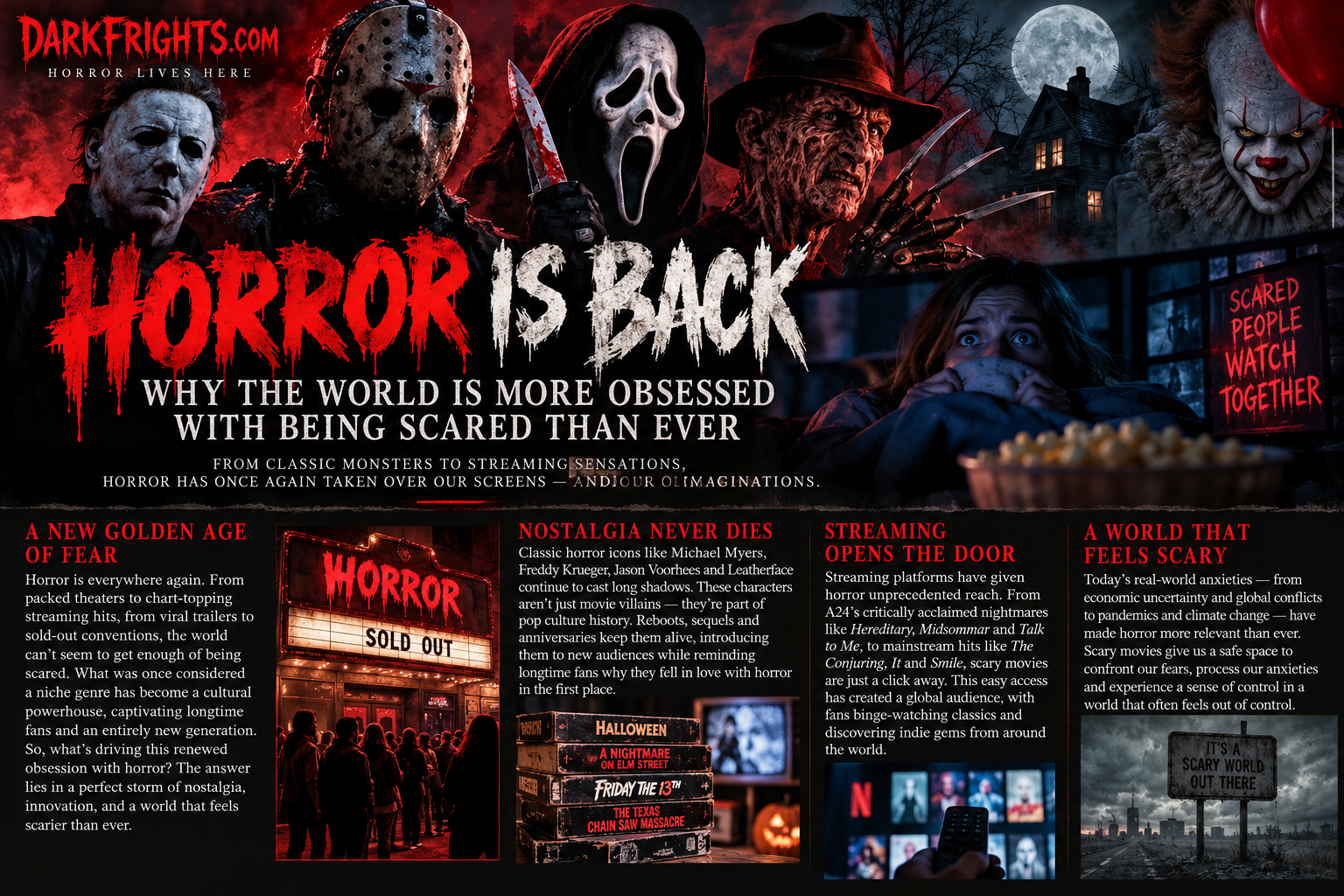
I’ve created the first DarkFrights.com horror graphic to accompany Article #1, using a dramatic red-and-black horror magazine style.
For the website, I’d use the graphic as the main feature image, with the full article text underneath it. That will keep the article readable on phones and give the site a professional editorial look.
We’ll carry this visual identity through all five articles, while giving each story its own distinct horror imagery.