

I am extremely claustrophobic. Not in the casual way people sometimes mean when they say they dislike tight spaces, but in a more immediate, physical sense. It is a true horror for me. The idea of confinement has a way of getting under the skin before a single image fully forms. Closed-in spaces, narrowing air, pressure without escape – these are not abstract fears, they are sensations the mind can stimulate too easily.
This is why the fear of being buried alive feels so universal and so enduring. Long before it became a cinematic trope or a literary device, it was one of the most primal nightmares people could imagine. There are few thoughts more suffocating than the idea of waking in total darkness, unable to move, unable to call out and realizing the world above has already made its final decision about you.
It is not simply the fear of death, it is the fear of remaining conscious inside of it.
When Death Wasn’t Certain
For most of human history, determining death was not as precise as it is today. Medical knowledge was limited and conditions such as deep comas, catalepsy and other unexplained states could make a living person appear completely lifeless. Breathing could be shallow enough to miss, a pulse could be undetectable and stillness could be easily mistaken for finality.

In that uncertainty, anxiety grew. The idea that somebody may be buried alive was not just superstition, it was plausible. Stories circulated of graves being opened too late, of bodies turned in unnatural positions and of scratches on the inside of coffin lids that suggested final moments of panic instead of peace.
Out of that fear came strange inventions. “Safety coffins” were designed with bells, flags and breathing tubes. All intended to give someone a chance to signal if they awoke underground. Whether any of these devices actually saved lives is uncertain. But their existence reveals something important: people were not afraid of death itself as much as they feared being buried alive.
Edgar Allan Poe’s Favorite Nightmare
Few writers are associated with premature burials as Edgar Allan Poe. While many horror authors have explored this fear, Poe seemed obsessed with it. Again and again, his stories returned to themes of entombment, confinement and the terrifying uncertainty between life and death. Long before horror films trapped audiences in coffins and underground chambers, Poe forced readers to confront the nightmare on the page.
The most direct example is The Premature Burial, a story built entirely around the fear of waking inside of a grave. What makes this tale so effective is that it is rooted in a very real fear of Poe’s era. The narrator becomes consumed by stories of people being mistakenly declared dead and his obsession gradually becomes the horror. The fear is not supernatural. It is entirely human, which makes it all the more unsettling.

Poe’s fascination with entombment appears throughout much of his work. In A Cask Of Amontillado, one of literature’s most infamous acts of revenge, unfolds deep within the labyrinth of the Catacombs. The victim is not buried alive but sealed alive behind a brick wall, fully aware of what is happening as his escape disappears one stone at a time. The horror comes from the same source as premature burial: consciousness trapped in a space that will become a tomb.
Perhaps nowhere is Poe’s obsession more apparent than in The Fall Of The House Of Usher. The story’s most memorable sequence involves Madeline Usher being placed inside of a vault before her death is truly certain. The suggestion that she may have been buried alive hangs over the narrative like a storm cloud, transforming the story from Gothic tragedy into something far more disturbing.
Across these works, Poe understood a truth that horror creators still rely on today. The coffin, the crypt, the sealed chamber and hidden vault all represent the same nightmare. They are spaces where movement ends, hope diminishes and the mind is left alone with realization that escape may no longer be possible. More than a century later, horror still returns to those images because few fears are as powerful as the fear of being trapped while fully aware of your fate.
The Coffin On Screen
Modern horror has returned to this idea repeatedly because it strips fear down to its most primal. There are no complicated monsters required, no sprawling mythology. There is only space, a body and the slow collapse of hope.
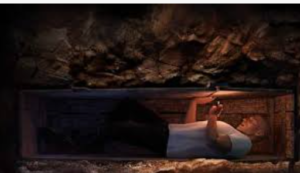
In Buried (2010), the concept is taken to a literal extreme. The entire film is wrapped around a man trapped in a coffin and nearly everything that happens inside that confined space. What makes it effective is not just the setting itself, but the way it forces the viewer to experience time as the character does. Every second feels measured. Every sound becomes significant. The walls never move but the pressure of them intensifies as the film continues.

In The Vanishing (original 1988, remake 1993), the fear is approached from a different angle. Rather than trapping the audience in a coffin from the outset, the film follows a man consumed with the disappearance of his girlfriend at a rest area. The search becomes the obsession and that obsession leads him to one of the bleakest conclusions in horror cinema. Unlike the American remake, which opts for a more conventional Hollywood ending, the original Dutch film refuses to offer comfort or justice.
That fear has also found a home in video games, though often in a less literal form. Titles such as Amnesia: The Dark Descent and Darkwood rely heavily on darkness, confinement and the feeling that the world is slowly closing around the player. Much like the films and stories before them, these games understand that claustrophobia is often more effective than any monster.
No One Is Coming
Medical science has made premature burial virtually impossible in the modern world. The uncertainty that fueled this fear has widely disappeared, replaced with more reliable ways of determining death. Yet the fear has not gone with it.
Perhaps that is because it was never really about medicine in the first place.
It was about awareness without agency. It was about existing without being able to act. It was about waking up in a place where every instinct screams for movement and discovering movement is no longer an option.
Like I stated, I am extremely claustrophobic and maybe that is why this particular horror lingers more than others. The idea of confinement does not need exaggeration to feel real. It only needs silence, darkness and the suggestion of walls that do not move.
Centuries may separate us from the era of safety coffins and medical uncertainty but the core image remains unchanged. Opening your eyes in total darkness, realizing you’re underground and understanding that no one is coming.
That is not just horror. It is finality with awareness still intact.