
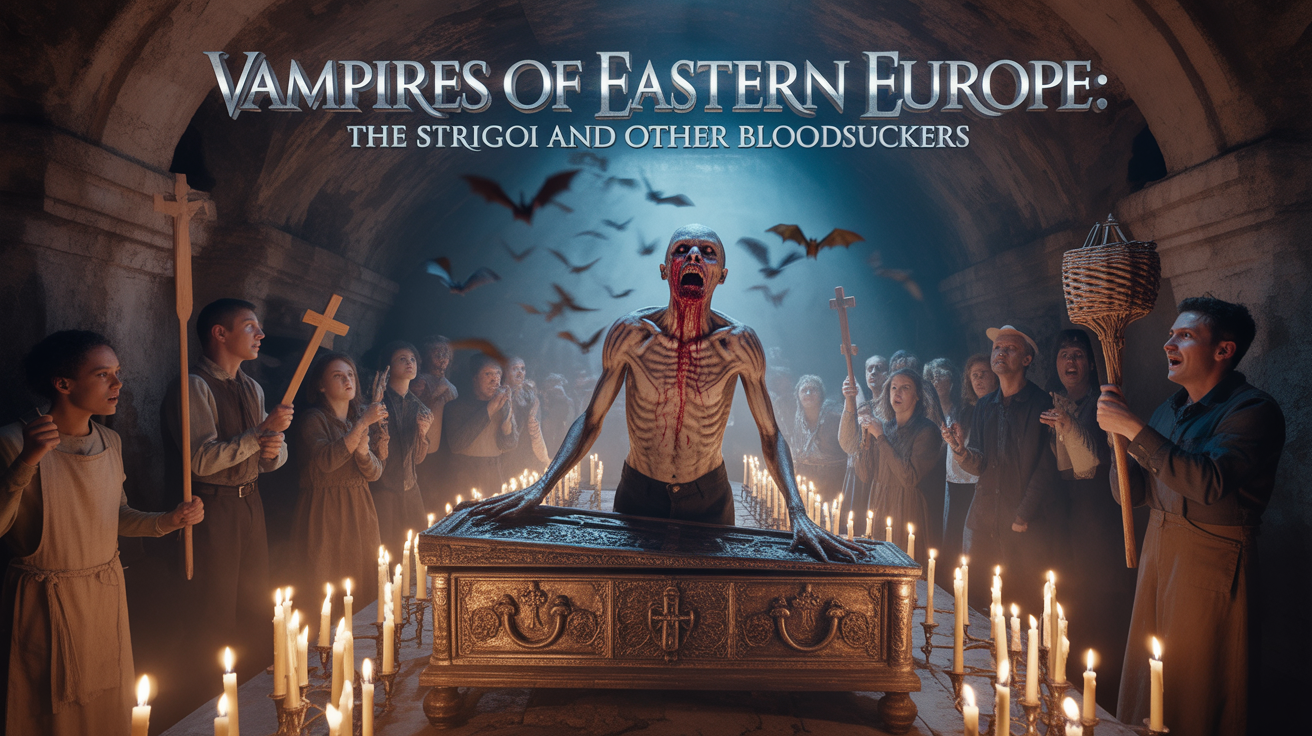
The night belongs to shadows, and in Eastern Europe, those shadows whisper of the strigoi—restless spirits, cursed revenants, and hungry bloodsuckers who walk between the world of the living and the dead. These tales stretch back centuries, woven into the fabric of villages where superstition was not just folklore but a matter of survival. To the people of Romania, Transylvania, and the Carpathian basin, vampires were not creatures of gothic romance. They were neighbors, lurking in graves and fields, waiting for the right moment to return.
The Cultural Roots of the Strigoi
The term strigoi comes from the Latin strix, meaning “screech owl,” a creature associated with omens of death and blood drinking. The idea carried through into Romanian folklore, where strigoi became the restless dead—spirits denied peace because of a cursed birth, violent death, improper burial, or sinful life.
For villagers of centuries past, life was precarious. Disease, famine, and sudden death could strike without warning. When someone died unexpectedly, especially in suspicious or terrifying circumstances, whispers of vampirism would spread. The strigoi served as an explanation for the inexplicable—why livestock died mysteriously, why crops failed, why families wasted away from illness.
But the strigoi were not limited to the dead. Legends also speak of strigoi vii—the living strigoi. These were people marked from birth: born with a caul, with extra nipples, or with a tail-like appendage. Such children were fated to rise as strigoi after death, and often lived cursed lives under suspicion. The living strigoi were thought to possess powers even before their resurrection, such as draining life energy, sowing discord, or transforming into animals under the cover of night.
Characteristics and Powers
The strigoi resemble much of what we now call the vampire, but with their own uniquely chilling flavor. Unlike the smooth, aristocratic Dracula of modern fiction, strigoi were feral, ravenous, and grotesque. Their powers included:
-
Blood Drinking: As with most vampire myths, strigoi survived by drinking the blood of the living, weakening their victims night after night until death followed.
-
Shapeshifting: Strigoi were said to take the form of wolves, cats, or even insects to slip unnoticed into homes.
-
Invisibility and Intangibility: Some stories told of strigoi walking unseen among villagers, whispering death into the ears of sleeping families.
-
Rising from the Grave: Their most feared ability—breaking through burial earth to stalk the living.
Villagers described them as pale, bloated corpses with red or darkened skin, sometimes with the wounds of their burial still fresh. Others claimed they were more spectral, shadows that slipped through cracks and keyholes.
Real-Life Sightings and Events
As unsettling as the legend is, history offers accounts of real communities taking drastic measures to protect themselves. In 18th and 19th century Romania and Serbia, vampire panics erupted when multiple people in a village died unexpectedly. Bodies would be exhumed, and villagers often claimed to find corpses suspiciously intact, as if they hadn’t decomposed properly.
One infamous case comes from 18th-century Serbia, where the corpse of a man named Petar Blagojevich was dug up after villagers reported nightly visitations. His body appeared fresh, with blood at the corners of his mouth. Convinced he was a vampire, they staked him through the heart and burned the remains.
Similar rituals occurred across the region. To stop a strigoi, villagers would pierce the heart with wood or iron, cut off the head, or burn the corpse. In some accounts, garlic, holy water, and ritual prayers were weapons as effective as any blade.
These rituals were not mere superstition—they were communal acts of defense, deeply tied to survival. In societies where the dead might literally return to torment the living, the grave was never considered final.
Influence on Modern Horror
When Bram Stoker penned Dracula in 1897, he tapped directly into this folkloric reservoir. Although Stoker never visited Transylvania, his notes reveal he borrowed heavily from accounts of strigoi, as well as scholarly studies of vampire superstitions. Dracula’s shape-shifting, blood-drinking, and unholy resurrection echo the strigoi in uncanny detail.
From there, the myth spread into Western imagination, fueling everything from the elegant vampires of Anne Rice’s The Vampire Chronicles to the feral creatures of films like 30 Days of Night. Even modern TV series such as The Strain (inspired by Guillermo del Toro and Chuck Hogan’s novel) borrow heavily from Eastern European vampire lore, especially the grotesque, parasitic features of the strigoi.
In Romania today, the vampire is both tourist attraction and lingering superstition. Tours of Bran Castle (often marketed as “Dracula’s Castle”) draw travelers from across the world, while rural communities still sometimes hold to old beliefs about the restless dead. In 2004, in the village of Marotinu de Sus, a group of villagers exhumed a man suspected of rising from the grave. They cut out his heart, burned it, and drank the ashes mixed in water—a ritual eerily close to those performed centuries ago.
Lessons and Cultural Significance
The strigoi represent more than monsters; they embody the fears of death, disease, and the unknown that haunted Eastern European life. These legends are warnings about the fragile balance between the living and the dead, and about the consequences of neglecting burial rites or dishonoring tradition.
On a deeper level, the myth of the strigoi underscores the belief that evil does not always remain buried. The past, if left unresolved, can claw its way into the present. For villagers, the strigoi were a way of making sense of misfortune—but also a reminder that respect for life and death was paramount.
Even today, the figure of the vampire remains potent not because of its sharp teeth or immortal beauty, but because it speaks to timeless human anxieties: that death is not an end, that something lost may return in corrupted form, and that the boundary between the living and the dead is perilously thin.
A Closing Chill
Picture a Romanian village centuries ago: the wooden church bells toll at dusk, fog curls through the graveyard, And doors are barred against the night. A dog growls at the darkness, ears pricked toward the freshly turned soil of a burial mound. Inside, a family huddles, clutching garlic and crucifixes, whispering prayers that the scratching at the window is just the wind—and not the strigoi come calling.
In Eastern Europe, the vampire was never a tale for candlelit parlors. It was a threat scratching at the door. A shadow moving in the field. A corpse that would not stay dead. And that, perhaps, is why the legend has never lost its power to terrify.