

Killers Who Watched, Waited and Returned
“He wore a mask. Not of leather, but of normalcy and no one ever thought to look beneath it.”
Throughout this series, we’ve traced the darkest corners of the human psyche. From foggy London alleys to the frozen wilderness of Alaska. We’ve met men and women whose brutality echoed through headlines, courtrooms and nightmares. But in our final article we turn to two predators who represent something different. They weren’t drifters, loners or outcasts. They were fathers, husbands, neighbors, yet they were calculating killers, until DNA evidence did them in.
Dennis Rader, the BTK killer and Joseph James DeAngelo, the Golden State Killer, didn’t just murder. They watched. They stalked. They returned to crime scenes. They sent letters. They made calls and fed on the fear they created. For decades, they eluded police, outwitted investigators and hid in their communities.
Their capture would only come after technology, time and hubris finally caught up with them. But not before they etched their names into the annals of American crime history.

Dennis Rader – The BTK killer
Dormancy and a Digital Mistake
BTK’s reign of terror began on a cold winter morning in Wichita, Kansas. January 15, 1974, 38 year old Joseph Otero, his wife Julie and their two children, 11 year old Joseph, Jr. and his sister 9 year old Josephine were all strangled to death inside their home. The family dog had been locked in the backyard and the phone lines cut.
The scene was so gruesome and clinical. Joseph had been strangled with a cord. Julie was found dead on the bed with her hands and feet bound, bruises around her neck. Joseph Jr. had clearly fought back before being suffocated with a plastic bag. But it was what happened to young Josephine that chilled even hardened detectives. Rader had hanged her in the basement using a rope and a pipe. Later, he admitted he masterbated at the scene after watching her die. The crime was deeply sadistic and clearly intended to satisfy his sexual desires and his unrelenting need for control.
He then killed Kathryn Bright in April 1974, Shirley Vian in March 1977 and Nancy Fox in December 1977. Each victim endured brutal endings at the hands of BTK. Bind. Torture. Kill. After Nancy Fox’s murder, he went into a woman’s home in 1979 and waited for her to return. When she didn’t, he left, later writing a letter to her describing how he waited and what he wanted to do to her. He finally killed again in 1985, when he abducted, tortured and strangled his neighbor, Marine Hedge. Each scene bore his perverse signature: bindings, trophies taken and a staged sense of ritual.
Then in 1991, Rader stopped killing and BTK vanished. The city of Wichita, tried to move on. Many believed he was either dead or imprisoned on other charges. Meanwhile, Dennis Rader lived quietly in Park City. He was raising children, living quietly and issuing code violations as a city compliance officer. He even earned a degree in criminal justice.
But BTK never really went away, he only went dormant, watching. Waiting. Reading the newspaper as his legend faded.

In 2004, the 30th anniversary of the Otero murders, something stirred in him. Bored and hungry for the spotlight again, he sent a letter to the Wichita Eagle. He included a photocopy of Josephine Otero’s stolen driver’s license and crime scene photos only the killer could have taken. He signed it simply, “BTK.”
What followed was a twisted game of cat and mouse. He left puzzles in cereal boxes, creepy dolls wrapped in plastic, their hands and feet bound and letters taunting the police. But it was a single floppy disc that did him in.
As part of his perverse game with investigators, Rader used personal ads in the newspaper to communicate indirectly with police, confirming drop locations and signaling his next move without drawing public suspicion. Ever meticulous, he asked detectives if floppy disks could be traced. The police lied and said no. He mailed it.
Metadata from the file linked the disc to Christ Lutheran Church and the user name “Dennis.” A simple search led them to Dennis Rader, church deacon, church president and a compliance officer. Investigators recovered DNA from his daughter’s medical records and familial DNA matched evidence from a 1974 crime scene.
On February 25, 2005, Rader was arrested. After 31 years, the man who terrorized Wichita had finally been captured. They had unmasked the mysterious, vicious monster hiding in plain sight, living among them.
Courtroom Confessions and a Chilling Legacy
When BTK was finally unmasked, what shocked the public wasn’t just his crimes, it was the man himself. There was no raving lunatic, no drooling monster. Instead, they saw a man in khakis and glasses, calm and eerily polite. In complete control as he recounted his crimes with chilling precision.
On June 27, 2005, Rader stood before a Kansas courtroom and gave one of the most disturbing confessions in the pages of American crime. Without emotion, he described binding and killing his victims in graphic, methodical detail. He named names, locations, dates and techniques that he used when either binding, torturing or killing his victims. He spoke like a man listing errands that he had done. He recounted how he stalked them, broken into their homes and watched them die.
He even corrected small errors that investigators had made, making sure that his record was accurate. When asked how he selected his victims, he said he had a particular type. He called them “projects” and was attracted to women who looked “Hispanic.” Dark eyes, dark hair. When asked why he killed, he offered a vague reference to “factor X,” some dark force that lived inside of him that he could not explain. There was no remorse. Only control.
He was sentenced to ten consecutive life terms, one for each known victim and sent to El Dorado Correctional facility in Kansas. He remains in solitary confinement and only allowed out of his cell for an hour a day.
BTK’s legacy is a terrifying blueprint, a killer who led a double life. He planned with surgical precision and thrived on the fear that he created. He didn’t just want to kill. He wanted to control. To dominate. He wrote letters taunting law enforcement, he gave himself a name. He wanted to be known.
And for thirty years, he got away with it.
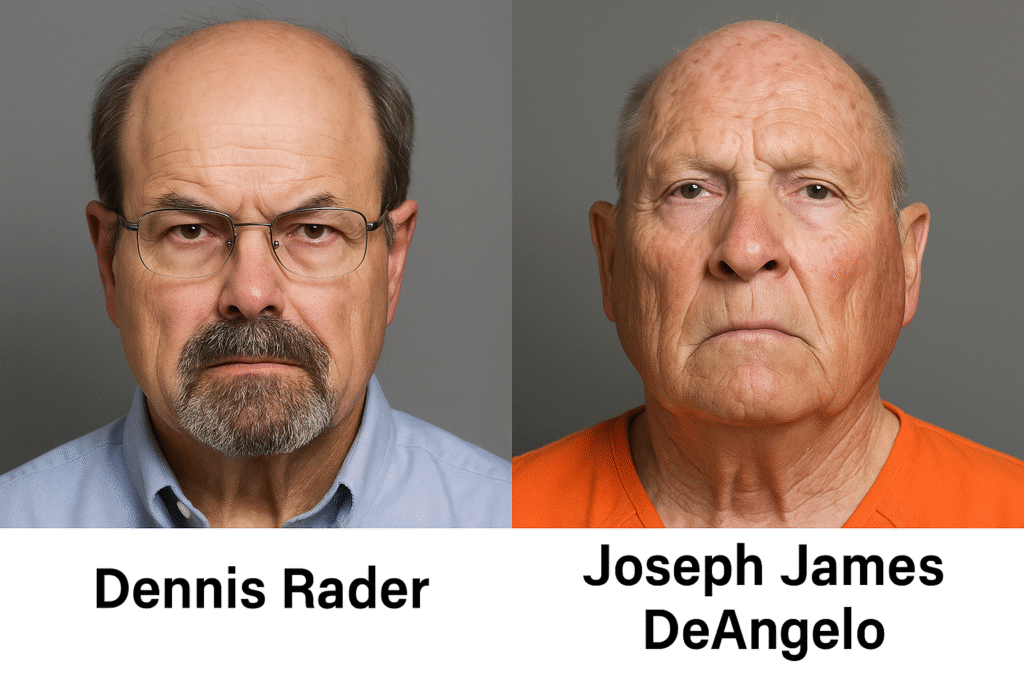
Joseph James DeAngelo – The Golden State Killer
The Predator With Many Faces
He was called many names: The East Area Rapist, the Original Night Stalker, the Visilia Ransacker, and eventually the Golden State Killer. He was a man who committed over 100 burglaries, 50 rapes and 13 confirmed murders across California. For decades, no one knew the waves of terror were all the work of one man.
Joseph James DeAngelo was a former police officer, a husband, a father of three and a man who vanished into the background of American suburbia for over 40 years, until DNA brought him back into the light.
His crimes began in the mid 1970s. In and around Sacramento, California, an unknown man dubbed, The East Area Rapist, began breaking into homes at night. He targeted women who lived alone and later couples. He would sneak in, wake them with a flashlight to the eyes and a gun. He would bind them with shoelaces, often placing dishes on the male partners, warning them not to move or the woman would die. He raped the women while their husbands or boyfriends lay helplessly nearby.
He didn’t just strike, he stalked. Victims later reported hang up phone calls, strange noises, missing items and unlocked windows or doors days before the attacks. Police found shoe prints outside of windows, often alongside scuff marks on fences or newly cut holes in screens. The man was meticulous. Patient. Terrifyingly smart.
When he moved south in 1979, his crimes escalated. The rapes stopped and the murders began. Couples were found in their beds, the men were shot and the women, raped and bludgeoned. The killer left almost nothing behind and the brutality increased. Investigators were left with no suspects. No fingerprints and no hope.
It would be decades before anyone realized that the East Area Rapist, the Original Night Stalker and the Visalia Ransacker were all the same man. By then, DeAngelo was a retiree living out a quiet life in a suburb of Sacramento and he would almost get away with it.
DNA, Genealogy and The Fall Of The Phantom
For decades police worked in vain to link the string of rapes, burglaries and murders terrorizing Calfornia. Despite composite sketches, behavioral profiles and countess tips, the man responsible remained hidden. He slipped through neighborhoods like a shadow, leaving behind nothing but trauma and silence.
Then came DNA.

By the early 2,000s forensic scientists confirmed what many believed, that the East Area Rapist and the Original Night Stalker were the same man. New testing techniques matched DNA from multiple crime scenes but there was still no match in national databases. Whoever he was, he had never been arrested, never been in the armed forces and had somehow kept his genetic footprint off the grid.
Until 2018.
Investigators turned to a new and controversial technique, genetic genealogy. Using publicly available DNA databases like GENmatch, detectives built a family tree from a partial crime scene sample. They narrowed it down through generations, cousins and birth records. Eventually all roads led to one name, Joseph James DeAngelo, a former cop with a disturbing past.
Police began tailing him. They retrieved DNA from a discarded tissue in his trash. It was a perfect match. On April 24, 2018, Joseph James DeAngelo was arrested outside his home in Citrus Heights, California. After more than four decades of evading justice, the Golden State Killer was in handcuffs. He barely spoke a word.
The Trial, The Victims and The Mask Removed
When Joseph James DeAngelo was brought into the courtroom, he appeared gaunt and frail. Barely speaking above a whisper. But those who had watched him in the days prior to his arrest knew the truth. This was a performance. Another manipulation. Surveillance footage showed him lifting heavy items, riding a bike and moving around his home with ease.
This was an old man undone by age. This was the Golden State Killer, a predator trying to put on one final mask. Hoping that, perhaps, the jury would feel sympathy for the frail retiree, that it would soften the blow of justice. It didn’t.
In June 2020, DeAngelo struck a deal to avoid the death penalty by pleading guilty to 13 counts of murder and 13 counts of kidnapping, along with admitting to dozens of rapes and assaults he couldn’t be charged with due to the statute of limitations. He sat silent while victim after victim stood to speak. Women now in their 50s, 60s, 70s recounting the nightmare he carved into their lives.
One woman said, “He stole everything. My safety. My family. My voice.”
Another said, “You were a monster then and you’re a coward now.”
In August 2020, DeAngelo was sentenced to multiple consecutive life sentences without the possibility of parole. He will die in prison, just another old man in a cage. But his legacy remains one of the most disturbing criminal sagas in modern history. A man who watched from the shadows, wore many faces and almost got away with it.
Evil Left Behind
Across this series, we’ve explored the most demented minds of the 20th century. Killers who took lives but shaped the way we understand violence, psychology and fear. From the bloodstained streets of Victoria London to the sun-bleached suburbs of California, each name carved its legacy in horror.
But there were others.
The century teemed with predators who didn’t make it into these articles. Men whose crimes defied logic and whose cruelty broke new ground. Jeffery Dahmer, the Milwaukee Cannibal, who turned murder into ritual and kept souvenirs of flesh and bone. Edmund Kemper, the Co-Ed Killer, a self aware giant who killed family before targeting young co-eds. Gary Ridgway, the Green River Killer, whose confessions stunned the world.
Europe was far from immune. From the Moors of England to the tenements of Soviet Russia, the 20th century saw killers emerge from every corner of the globe. Each one as brutal, calculated and unforgettable as their American counterparts. Andrei Chikatilo, the Butcher Of Rostov, who murdered and ate children in the shadow of the Soviet collapse. Peter Sutcliff, the Yorkshire Ripper, whose crimes terrorized England for over five years. Ian Brady and Myra Hindley, whose Moors Murders left Britain forever scarred.
Perhaps the most chilling of all are the ones who were never caught. The Zodiac Killer, still nameless, still taunting police from the cold files. There are others, too many to name. Some were infamous. Some forgotten. But each contributed to a century that saw the rise of the serial killer as a cultural icon. Monsters who walked among us. Smiled in photographs. Raised families and killed when no one was looking.
The End Of The Road – For Now
Demented Minds Of The 20th Century was never just a catalog of crime. It was a study in deception. How evil hides among us, in laughter. In law-enforcement uniforms. In gentle faces. It was about control, deception and the human urge to dominate and destroy.
We cannot afford to pretend these people never existed. So we remember the victims. We study the killers and we call it what it was: madness.
Though this series closes, the shadows remain…there will always be more.