

Horror cinema did not emerge fully formed from gothic castles and fog shrouded graveyards. It was dragged into existence by outsiders – by people that understood cruelty, obsession, deformity and spectacle not as abstract ideas, but as lived experience. Among the most important of these pioneers stands Tod Browning, a director whose work remains unsettling precisely because it refuses comfort. Browning did not simply invent frightening images. He changed what horror was allowed to look at and on whom it was allowed to center.
Long before horror became a genre of jump scares and sleek monsters, Browning’s films insisted on something far more disturbing. The idea that the real terror often lies in the so-called normal world, and that society’s true monsters wear human faces.
A Life Steeped In The Macbre
Charles Albert Browning, Jr., born in 1880, ran away from a controversial life at an early age and joined the world of carnivals, sideshows and traveling circuses. This was not a brief flirtation with spectacle, it was a formative education. Browning worked as a barker, a performer, a magician’s assistant, absorbing the rhythms of sideshow life and witnessing firsthand how society both consumed and rejected those it labeled as “other.” These were places where bodies deemed abnormal became commodities, where exploitation and community existed side by side.
This background would permanently shape Browning’s worldview. Unlike many filmmakers that treated deformity, disability and their difference as visual shorthand for evil. Browning understood these spaces intimately. He saw how cruelty flowed downward from audiences who paid to laugh, gawk, recoil and how survival often required solidarity among those on display. When Browning later turned to film, he brought this understanding with him, refusing to sanitize it for mass comfort.
Collaboration With Lon Chaney- Horror Of The Body and Soul
Browning’s partnership with Lon CHaney in the silent area produced some of the most psychologically complex horror films ever made. Chaney, known as “The man with a thousand faces,” was uniquely suited to Browning’s vision. Together, they explored characters who were physically altered, socially isolated and emotionally tormented. Not as villains, by default but as tragic figures shaped by a hostile world.
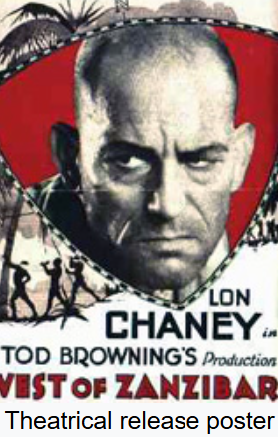
Films like The Unholy Three (1925), The Unknown (1927) and West Of Zanzibar (1928) revolve around disguise, mutilation and obsession. In The Unknown, Chaney plays a man who pretends to be armless, only later to mutilate himself to fulfill the lie. This is not horror rooted in supernatural threat but in self-annihilation, desire and identity. Browning understood that the body could be a site of terror without a single ghost or curse in sight.
What made these films revolutionary was their refusal to moralize simplistically. Browning did not ask audiences to recoil from Chaney’s characters, he asked them to understand them. The horror came from obsession, repression and the violence inflicted by rigid social norms. These psychological depths predate and arguably anticipate modern horror’s fascination with trauma and mental collapse.
Dracula and The Birth Of Atmospheric Horror
Browning’s Dracula (1931) is often discussed as a studio bound relic of early sound cinema, but its influence is difficult to overstate. Rather than relying on spectacle or gore, Browning leaned into atmosphere, silence and stillness. His Dracula is not a creature of constant motion. Instead he is a presence, looming and invasive, dominating rooms simply by standing in them.
This restraint was radical. He allowed pauses to stretch uncomfortably long, used shadows to imply rather than reveal. Browning treated horror as something that seeps into the frame rather than burst into it. Bela Lugosi’s performance, guided by Browning’s direction, turned the vampire into an icon of predatory elegance, foreign and quietly threatening.

In doing so, Browning helped define horror as a genre that was capable of dread without excess. Modern, slow-burn horror owes a considerable debt to this approach, even when it refuses to acknowledge the lineage.
Freaks – The Film That Changed Everything
If Browning’s legacy rested on a single film, it would be Freaks (1932). A work so confrontational that it nearly ended his career. Using real sideshow performers rather than actors in makeup, Browning created a film that stripped away the comfortable distance between audience and subject. The performers are not metaphors; they are people, presented with dignity, humor and camaraderie.
The true villains of Freaks are the physically “normal” characters who exploit, manipulate and mock the sideshow community. Browning inverts expectation, forcing viewers to confront their own prejudices. The now famous chant, “one of us, one of us,” it’s not merely eerie, it is accusatory. It dares the audience to decide who truly belongs in the category of monster.

The backlash was swift and brutal. Audiences recoiled, critics condemned it and the studios distanced themselves. Yet this reaction only proves Browning’s point. Freaks horrified because it exposed the truth that viewers were unwilling to face. Cruelty often hides behind beauty and that differences are only frightening when stripped of humanity.
Today, Freaks is recognized as one of the most important films in cinema history, not because it scares easily, but because it refuses to reassure.
A Pioneer Who Paid The Price
Browning’s career declined after Freaks and he never again enjoyed the same level of creative freedom. Hollywood had little tolerance for horror that implicated its audience instead of comforting it. Yet his influence persisted, quietly shaping generations of filmmakers who recognized that horror could be intimate, psychological and social transgressive.
From body horror to exploitation cinema, from psychological thrillers to modern outsider narratives, Browning’s fingerprints are everywhere. He demonstrated that horror does not need monsters from beyond. It requires honesty about the monsters we create through fear, desire and exclusion.
Why Tod Browning Still Matters
Tod Browning is considered a pioneer of horror because he understood something essential: fear is not born from the unknown alone, but from recognition. His films force us to recognize our capacity for cruelty, our fascination with indifference and our willingness to dehumanize when it suits us.
In an era when horror often chases novelty, Browning’s work remains disturbingly fresh. It lingers, not because of what it shows but because of what it refuses to let us ignore. Horror, in Browning’s hands, was never just entertainment, it was confrontation.
That, in my opinion, may be the most frightening legacy of all.