

Children are supposed to represent innocence. Small hands clutching toys. Scraped knees and laughter echoing through playgrounds. They symbolize potential, the idea that the future might be brighter than the past. Horror, however, thrives on twisting what we think is safe. When the monster is a child, the effect is deeply unsettling. It violates some of our most primal instincts: the urge to protect the young. Instead, horror asks us to imagine something far worse, that sometimes the child is the thing we should fear.
Throughout the history of the genre, filmmakers have repeatedly returned to this disturbing idea. The child in horror could be the natural born predator, a vessel for ancient evil or something that has never been human at all. Perhaps most unsettling of all, they often look perfectly innocent while doing terrible things.
The Born Monster
One of the earliest and most chilling examples of an evil child appears in The Bad Seed (1956 remade 2018). The film centers on Rhoda Penmark, a polite, well mannered little girl who seems like the perfect child, until it becomes clear that she is capable of cold blooded murder. Rhoda does not kill in fits of rage or passion. She plans, she manipulates and eliminates obstacles with the quiet calculation of an adult psychopath.
The horror here isn’t supernatural. It’s genetic. The story suggests that some people might just be born bad. Without empathy, and when the lack of conscience appears in a child, it becomes terrifying. Rhoda’s pigtails and sweet smile become a mask hiding something far more disturbing, a predator that knows that adults underestimate her.
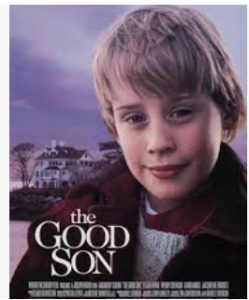
Another unsettling portrayal of a child without compassion appears in The Good Son (1993), In the film, young Henry Evans seems like a normal boy at first. But his behavior gradually reveals something deeply disturbed under the surface. Henry treats cruelty like a game. Sadistic, manipulating those around him and pushing the boundaries of violence with chilling calmness. The terror comes with the realization that some children lack the moral compass that restrains everyone else.
The Possessed Child
If the born monster suggests that evil can grow naturally, the possessed child offers something worse, that innocence can be a battleground for ancient forces.
Few films have captured this idea as effectively as The Exorcist (1973). Ragan MacNeil begins the story as a sweet, ordinary girl. But her possession by a demonic entity transforms her into something grotesque and blasphemous. Her voice deepens into something inhuman. Her body twists and contorts unnaturally and her behavior becomes increasingly vulgar. What makes the film so disturbing is the contrast between the innocent child the audience first meets and the vile ancient presence that eventually speaks through her.

Another chilling variation on this theme appears in The Exorcism Of Emily Rose (2005). Inspired by a real case, the film follows a young woman whose violent possession leads to her death during an attempted exorcism. The story unfolds in a courtroom, where doctors argue that Emily suffered from mental illness while priests insist something darker had taken hold of her soul. The uncertainty only deepens the horror, raising the possibility that faith, science and fear were all colliding around a young life that became the battleground for something unseen.
Possession narratives remain powerful because they attack a fundamental fear: that something pure can be corrupted, turned against those who love it.
The Inhuman Child
Sometimes the child in horror isn’t possessed or psychologically disturbed. Sometimes the child was never human to begin with.
The eerie children in Village Of The Damned (original 1960, remade 1995) embody this idea perfectly. After a mysterious event in a small town, several women give birth to strange, platinum-blonde haired children with glowing eyes and psychic abilities. The children share a collective intelligence and view humanity with cold detachment. They are calm, polite and utterly merciless.

The same concept appears in The Omen (original 1976, remake 2006), where young Damien Thorne slowly reveals himself as the Antichrist. Unlike many monsters in horror, the demon rarely acts directly. Instead, horrifying events happen around him as if the universe bends to his dark purpose.
The terror in these films comes from helplessness. How do you stop something that looks like a child but carries the power of something ancient and unstoppable?
The Cult Child
Another frightening twist happens when children act together, creating a collective threat rather than one monstrous individual.
In Children Of The Corn (original 1984, remake 2009), a group of rural children murder every adult in town to serve a mysterious entity known as “He Who Walks Behind The Rows.” Led by the young preacher, Isaac, the children enforce brutal religious laws, sacrificing anyone who challenges their authority.
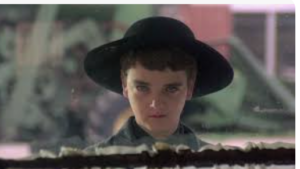
A similarly disturbing idea appears in Who Can Kill A Child (1976). In this Spanish horror film, a vacationing couple arrives on a quiet Mediterranean island only to discover that every adult has been slaughtered. The children roam the streets laughing and playing, united by a shared chilling purpose. Unlike the organization of Children Of The Corn, these children seem bound together by an eerie collective instinct, turning the entire island into a deadly playground.
What makes these films so unsettling is the inversion of power. Children, who are meant to learn from adults, instead overthrow them entirely, creating a world where innocence becomes a weapon.
The Vengeful Child
Not every terrifying child in horror begins as a monster. Sometimes the horror grows from tragedy, transforming a victim into something far more dangerous.
In The Ring (2002), the ghostly figure of Samara Morgan spreads a supernatural curse through a videotape. Anyone who watches the tape receives a phone call announcing their death in seven days. Samara herself was a deeply troubled child whose abuse, suffering and rage manifest into a relentless, supernatural force.

A similar haunting happens in Dark Water (original Japanese 2002, American remake 2005). In this ghost story a struggling mother and her daughter move into a decaying building plagued by mysterious leaks and unsettling occurrences. Eventually it becomes clear that the building is haunted by the spirit of a lonely girl who was abandoned and left to die. Her sorrow lingers like the water stains spreading across the ceiling, turning the building into a place soaked in grief.
This type of story falls under the powerful tradition often called “ghost child revenge tale.” These narratives blur the lines between victim and monster. The spirit is terrifying but it’s also a product of cruelty, violence or neglect. The haunting becomes less about evil and more about pain that refuses to fade away.
The Unsettling Power Of The Evil Child
Children in horror work so effectively because it disrupts our expectations. We are conditioned to see children as helpless, fragile and deserving protection. When horror flips that idea, the results are deeply uncomfortable.
A snarling monster or masked killer is frightening, but they are also expected. A child quietly standing in a hallway, staring with emotionless eyes, can be far more disturbing.
In the end, the child trope reminds us that horror doesn’t always need claws, fangs or elaborate special effects. Sometimes all it takes is a small figure in the dark…and the slow realization that the thing looking back at you is not as innocent as it appears.