

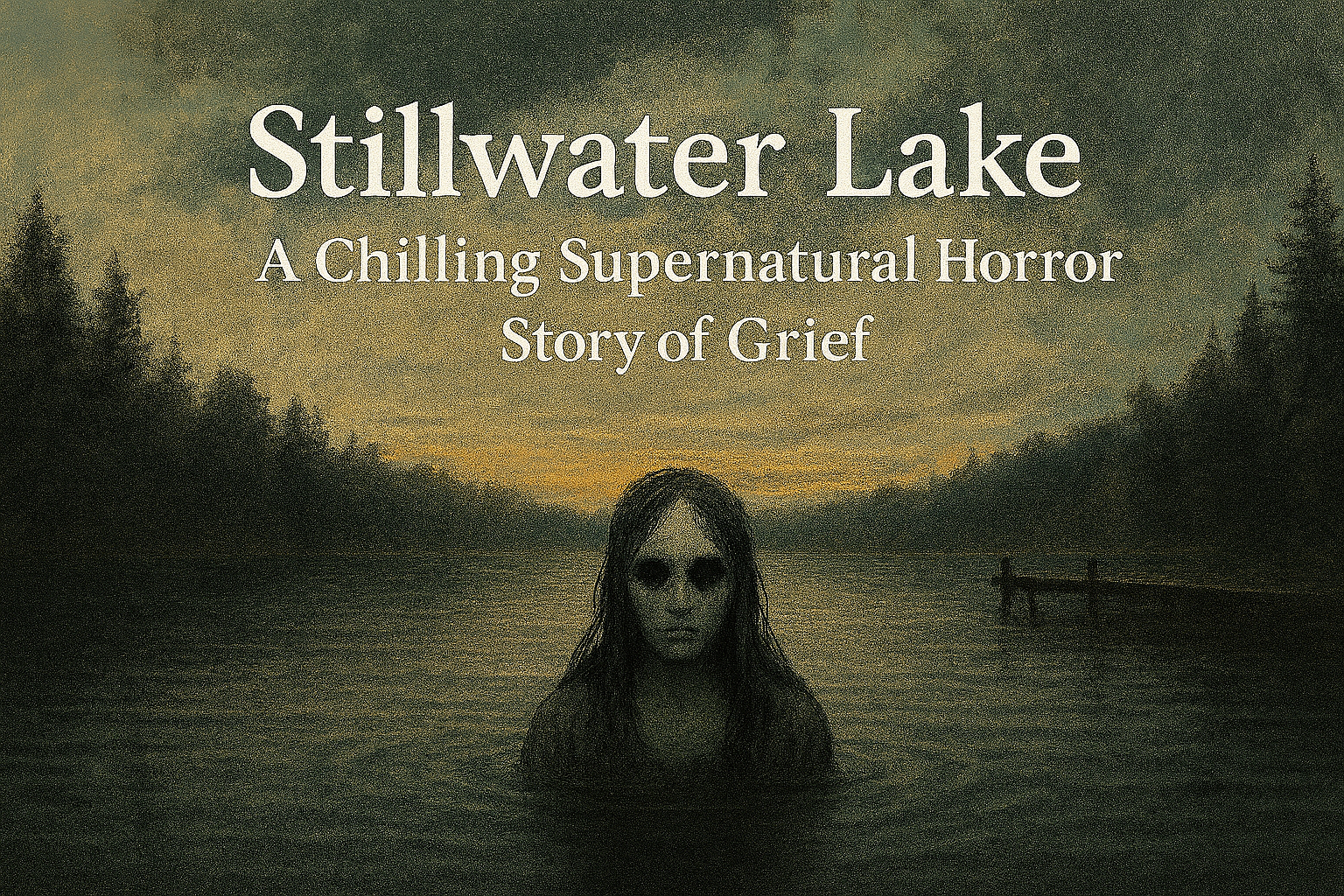
The Water Was Breathing
The water steamed in the morning light like the lake was breathing.
Mist curled off the still surface in slow, deliberate exhalations, and the dock groaned under the weight of something unspoken. At the end of it stood a little girl in soaked pajamas, barefoot, her strawberry-blonde hair clinging to her face. Her name was Gracie Lambert. She was eight years old and had been missing since the night before.
Now she stared blankly across the water, lips parted, as if something was still speaking to her from beneath the mirror-like lake.
Sheriff Miller’s cruiser screeched into the gravel lot moments later, and her parents ran toward her screaming. Gracie didn’t move. Her arms were stiff at her sides. Her skin, strangely, radiated warmth.
“She was singing to me,” Gracie whispered as her mother wrapped her in a towel, sobbing. “In the dark. Under the water. She said it was okay now. She said I could stay.”
Gracie hadn’t just sleepwalked. She had vanished. Search dogs had combed the woods. Boats had circled the shore. Divers had plunged into the lake’s deepest belly. No one had found her.
Yet here she was.
And she wasn’t the first child this summer to wander into the water and return with no memory, no answers — only a calm, dazed expression, like a spell had been broken just long enough to let them go.
And the water was still warm.
Unnaturally warm.
The Arrival
Caleb Brewer didn’t believe in ghosts.
But the first time he and his son Eli stepped out of the car and into the soft pine-scented air of Stillwater Lake, he felt something… shift. It was subtle, like the catch of a breath or the memory of a scream muffled by distance. The lake stretched before them, impossibly smooth, like a black mirror laid flat across the earth.
“This is it,” Caleb said, trying to sound upbeat. “Our getaway.”
Eli didn’t respond. He was ten and had barely spoken a word since his sister Emily drowned the year before. Caleb had hoped this trip — some forced father-son time away from screens and reminders — would break the silence between them. So far, it wasn’t working.
The cabin was postcard-perfect: weathered wood, flower boxes, and a creaky front porch. The woman who handed them the keys was not.
“Name’s Mrs. Langley,” she said. Her hands were bony, her eyes the color of a fading bruise. “Cabin’s stocked. No TV. No Wi-Fi. Water comes straight from the lake.”
“That’s fine,” Caleb said, forcing a smile. “We’re here to unplug.”
She nodded, but her gaze drifted toward Eli. “He’s a quiet one.”
“He’s… been through a lot.”
Mrs. Langley pursed her lips. “Stillwater’s an old place. The lake remembers things. Don’t let him go in alone.”
That night, after unpacking, Caleb sat on the porch with a beer while Eli drew in his sketchbook by flashlight. The lake hummed softly — not a real sound, but a pressure, like the world was listening.
Locals they passed earlier in town had been friendly enough, though more than one made offhand remarks about the lake being “weird” this year. “Warm as soup,” one woman said. “Makes folks act funny.”
Caleb brushed it off. The only thing strange was how calm the lake was — not a ripple, not a sound. And the air, even at night, clung like wet cotton. The breeze smelled faintly sweet, like old lilies.
Eli yawned, closing his sketchbook.
“Ready for bed, bud?” Caleb asked.
Eli nodded and stood — then paused, looking out at the water.
“She’s under there,” he said quietly.
Caleb blinked. “What did you say?”
But Eli had already turned toward the cabin, the screen door slapping behind him.
Caleb stared at the lake long after the sun was gone.
Rising Unease
Caleb awoke to the creak of floorboards.
He rubbed his eyes and checked the clock: 3:12 a.m. Eli’s bed was empty.
His heart leapt into his throat as he threw on a flannel shirt and padded through the cabin. The front door was ajar, screen swinging. Panic rose in his chest like bile.
Outside, the fog was thick and wet, clinging to his skin. The lake shimmered in the moonlight — and there, standing at the shoreline, was Eli.
Caleb ran. “Eli!”
The boy turned slowly, eyes wide, as if startled to be outside at all. His feet were bare, soaked up to the knees.
“I was just listening,” Eli murmured.
“To what?”
“The singing.”
Caleb knelt and took him by the shoulders. “You can’t go out there alone. Ever. Understand?”
Eli nodded, but his gaze drifted back to the lake. “She’s sad.”
They went back inside. Caleb didn’t sleep.
The next few days blurred in haze and heat. Caleb tried to keep things normal — fishing, hiking, card games — but Eli was different. Distracted. He would sit for hours on the dock, staring at the water, mumbling under his breath. Stopped eating much. He drew constantly.
On Thursday morning, Caleb glanced at one of his sketches while cleaning up.
It was a picture of a woman beneath the water, her hair floating around her head like seaweed. Her eyes were black, her smile too wide. She held Eli’s hand.
Scrawled at the bottom: “Our new mommy.”
Caleb felt something cold grip his spine.
That night, thunder rumbled in the distance. Caleb sat out on the porch with a second beer and tried to convince himself this was just grief. A kid’s way of coping.
Then he saw her.
For a moment — just a moment — in the dark water, a pale figure broke the surface. Long black hair. Bare shoulders. And then gone.
He dropped the bottle. Glass shattered across the porch.
On Friday, he went to town.
The sheriff was no help. “Kids do strange things out here. It’s nature. Peaceful. Clears the head.”
But at the gas station, the young cashier leaned in close when Caleb mentioned the lake.
“My cousin’s boy went weird, too,” she whispered. “Wouldn’t speak. Kept walking into the water at night. They had to chain the doors.”
“What is it?” Caleb asked.
She shrugged. “People say there’s a woman in the lake. Been there a long time. Waiting.”
Back at the cabin, Caleb found Eli in the shallows, humming.
“What are you singing?” Caleb asked.
Eli looked up and said, “Her lullaby.”
That night, Caleb had the dream again: a woman in a black dress, submerged beneath the water, her arms open wide. His daughter Emily floated behind her, pale and smiling.
When he woke, the lake was whispering his name.
The History of Stillwater
Caleb drove into town the next morning under a gray, swollen sky. Eli stayed behind, unusually quiet, drawing again by the window. Caleb left him with a strict warning: “Don’t go near the lake.” Eli didn’t reply. He didn’t need to.
Caleb wasn’t sure what he was looking for, only that he couldn’t ignore it anymore — the warmth of the water, the things Eli was saying, the way the dreams were creeping into the day. There was something here. Something old.
He ended up at the Stillwater Historical Society, a little one-room museum with dusty glass cases and faded photographs. An elderly volunteer named Muriel greeted him from behind a desk.
“I’m looking for any records about drownings at the lake,” Caleb said.
Muriel raised a gray eyebrow. “Lot of folks drown in lakes, mister.”
“I know. But I think there’s a pattern.”
At first, she waved him off — until he mentioned Mrs. Langley.
Her face went still.
“You staying in her cabin?” she asked. “Didn’t know she was still renting that place.”
Caleb nodded.
Muriel sighed, then stood slowly and walked to a locked drawer. She pulled out a thin file and placed it on the table.
“Margaret Langley,” she said. “Her daughter. Summer of ’63.”
The file contained a newspaper clipping: LOCAL GIRL DROWNS IN STILLWATER. The grainy photo showed a teenage girl with soft eyes and a shy smile. The article said she had been pregnant. The father had run off. Margaret walked into the lake and never came back.
“No body?” Caleb asked.
Muriel shook her head. “None. That lake’s deep. Has caves underneath. Cold currents. She vanished.”
Caleb leafed through a few more clippings. Other drownings. 1975. 1986. 1998. 2010. Always kids. Always in the hottest part of summer. The lake, each time, had been unusually warm.
“The town stopped talking about it,” Muriel said. “Got tired of the stories. Called it grief, coincidence, freak weather. But the old ones… they said the lake remembers.”
Caleb found an old journal on display, written by a settler from the 1800s. One line chilled him:
“The water sings at night. It calls to the lonely, the lost. It keeps what is given… and it waits for more.”
That evening, back at the cabin, Caleb confronted Mrs. Langley.
“She’s not gone, is she?” he asked.
Mrs. Langley looked at him from her porch chair, knitting needles motionless. Her eyes, now sharp and knowing, met his.
“She was pregnant,” she said softly. “She wanted a family. The lake… gave her what it could.”
“Eli,” Caleb whispered.
Mrs. Langley nodded once. “It doesn’t want death. Not anymore. It wants what it lost. It wants a home.”
Confrontation
Eli was gone.
The front door was open. His shoes still by the mat. The sketchbook lay on the floor, a fresh drawing etched in frantic strokes: Eli, smiling, hand-in-hand with the woman from the lake. Below them, written in jagged letters: “We’re going home.”
Caleb ran.
The dock was empty, moonlight reflecting off the water in wide, trembling sheets. He scanned the shoreline, heart hammering, lungs already burning.
“ELI!”
No answer.
Then — a ripple.
A tiny circle widening outward, thirty feet from shore.
He stripped off his shirt and dove in.
The water was hot. Not warm — hot. Like bathwater left out in summer sun. It enveloped him with impossible weight, thick and syrupy.
He kicked down, down, deeper than he’d ever dared before. His eyes stung, the darkness closing around him.
Then, he saw her.
The woman. Margaret.
She floated in the blackness, her hair drifting like ink in water. Her skin glowed faintly. Her eyes opened — two perfect, gleaming voids.
Eli was in her arms.
His small hand clutched her fingers like she was his mother.
“No,” Caleb screamed, his voice lost to the water. He swam toward them, heart pounding.
Margaret looked at him with something close to pity.
He is mine now, the voice came, not in sound, but in Caleb’s mind. You gave her up. I will not.
Caleb reached for his son, and Margaret’s grip tightened. Eli’s face remained peaceful. Serene.
“Take me instead!” Caleb thought. “Let him go!”
But she only shook her head.
You were never a father. He needs a mother.
Caleb screamed and lunged. He grabbed Margaret’s wrist, trying to pull her away — but the lake pulled back.
In that moment, he stopped fighting.
He wrapped his arms around both of them — Margaret and Eli — and forced himself down, deeper, into the choking dark.
Margaret shrieked, the water trembling. Her body twisted. Her grip loosened.
And then she let go.
Eli’s body floated upward, limp but rising, air bubbles trailing from his mouth.
Caleb’s limbs grew heavy.
The last thing he saw before the darkness swallowed him was his son breaking the surface.
Aftermath
Eli awoke coughing on the dock, water spilling from his mouth in great gasping heaves. His lips were blue. His hands shook. But he was alive.
They found him just before dawn, curled beneath a towel left by the cabin steps. Sheriff Miller said he must’ve fallen in and floated back. “Lucky kid,” he muttered. “Could’ve gone real bad.”
No one mentioned Caleb.
Divers searched the lake for two days. Nothing. No body. No clothes. Not even air bubbles.
Eventually, the sheriff called it a tragic accident. Another grieving father who couldn’t face the weight. “The lake takes what it takes,” Mrs. Langley whispered as they lowered the search buoys.
But Eli knew.
He stopped talking after that. Stopped drawing. Stopped humming the lullaby. When he went home with his aunt — his new guardian — he refused to go near bathtubs. He flinched when he heard water boiling on the stove. And sometimes, in the quietest hours of night, he would whisper:
“Thank you, Dad.”
Stillwater Lake cooled as summer ended. The mist faded. The water stilled. Tourists stopped coming early that year. Something about the air not feeling right.
Locals said it was just grief lingering like a fog. Happens every few years.
One late September morning, a boy from town walked down to the shore. He skipped a stone across the glassy surface. One, two, three bounces… then it vanished.
But the ripples didn’t stop.
They widened. Deepened. Something pale shimmered below — something long-haired and open-armed, just beneath the glass.
The boy backed away, sensing something old, something waiting.
The water stilled.
And far below, the lake opened its arms again.
Enjoyed this story? Share the chills.
If you loved Stillwater Lake, help us keep the horror alive.
📘 Like us on Facebook: DarkFrights
🐦 Follow us on X: @darkfrightsmag
📸 Creep with us on Instagram: @darkfrightsmag
Subscribe for more original horror delivered straight to your veins. Darkness awaits.