

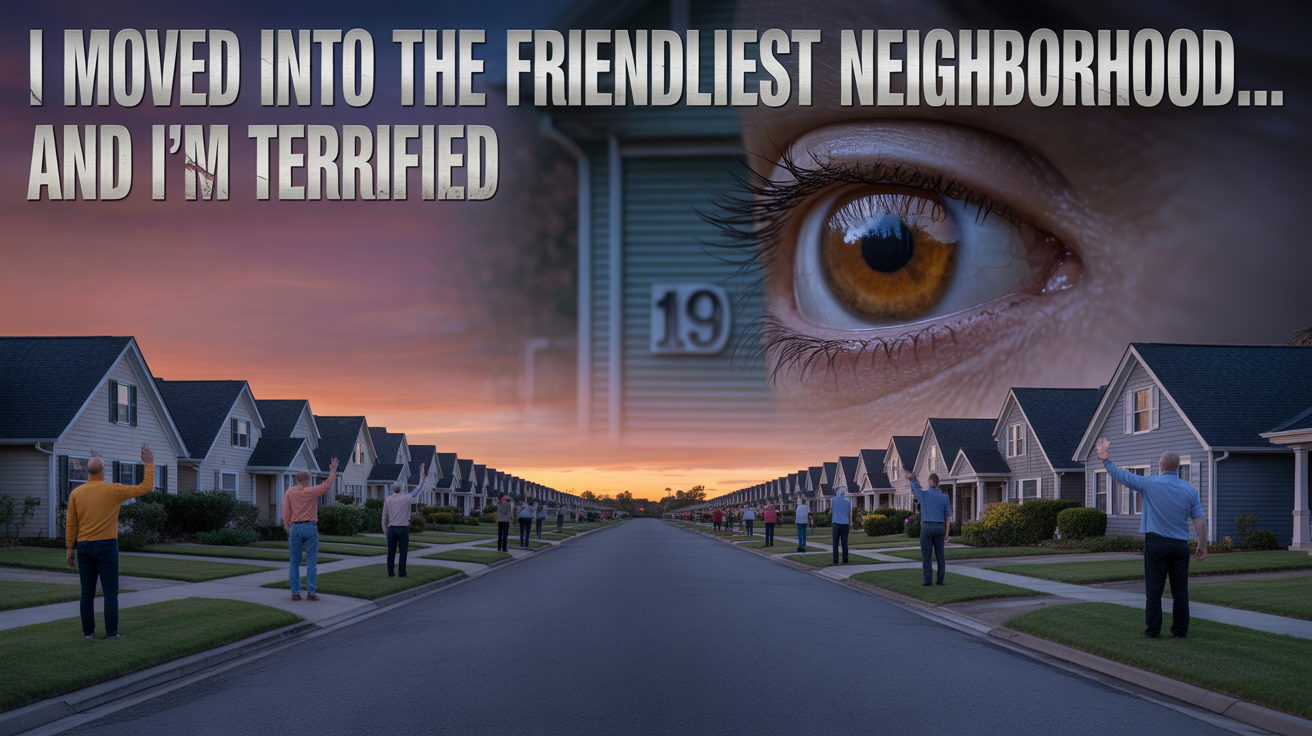
I pull into Cedar Way on a Tuesday afternoon, the kind of late-summer heat that makes asphalt look like it’s breathing. The houses here are clones — neat lawns, white trim, potted geraniums all sprouting the same cheerful red. I kill the engine and sit for a second, just to enjoy the quiet.
Then I notice the people.
They’re already on their lawns. All of them. Not mowing, not chatting. Just standing like they’ve been waiting for me, arms relaxed at their sides, gazes pinned to my car. When I step out, they wave — at the exact same speed, the exact same angle, like they practiced.
I laugh out loud. “Okay, creeptown,” I mutter, and lift my hand back. It feels like waving at a mirror.
They’re absurdly friendly. Casseroles appear before my fridge is plugged in. “Welcome to Cedar Way,” says a woman who introduces herself as Mrs. Halvorsen; her handshake is warm and firm and lasts two beats too long. She doesn’t blink the entire time we talk. Mr. Hughes, across the street, has a grin so perfect it looks glued on. When I try to make small talk — moving from the city, remote job, looking forward to quiet — every conversation drifts the same way.
“You’re settling in, right?” Mr. Hughes asks. He steps closer, like he wants to smell my answer. “You are staying?”
The emphasis makes a knot twist under my ribs. I joke, “I signed a lease,” and he laughs exactly two notes: ha-ha. He doesn’t open his mouth when he does it.
There’s one house nobody mentions. Number 19. Faded blue siding. Blinds drawn. The grass there is cut too short, scalp-showing. When I glance at it, I get the sense of something holding its breath.
The first night, I sit on the porch with a beer and watch a swollen orange moon ease up over the rooftops. Across the street, Mrs. Halvorsen waters her flowers. She holds the hose in one hand and stares at me with the other. Her eyes don’t leave my face as the water patters on her hydrangeas and the stream drifts into the street.
The next morning, Mr. Hughes jogs past my window. His knees pump. His arms swing. Sweat slicks his temples. His head doesn’t move at all. Not a bob. Not a tilt. His smile doesn’t flicker. He thumbs-up my house without breaking rhythm, and somehow it feels like he’s tapping me between my ribs.
On day three, I find a flyer stuck beneath my door mat, cream paper and polite fonts. Cedar Way HOA Courtesies: No garbage bins visible from the street. Thursday is yard day. Do not play music after 7 p.m. If you see anyone looking out of the upstairs window at Number 19, please do not wave. Welcome walks are at 7:03 a.m. Participation expected where possible.
I tuck it in a drawer and tell myself it’s normal. My brain keeps snagging on that last one. 7:03? The specificity tickles something I don’t like.
Day four, 7:03 on the dot, the neighborhood passes my house in single file. Young, old, kids, teens, retirees. No phones. No strollers. No one speaks. The sound of shoes — thump-thump-thump — has a hollow quality, like the pavement is a drum. The moment the last person passes my driveway, Mr. Hughes breaks rank and turns to me, still walking in place so the footsteps don’t go out of sync.
“Come join us,” he says, and the words reach my ears, but his lips stay perfectly still.
“Maybe tomorrow.” I force a smile and my cheeks ache. The line rounds the corner like a snake.
That night, as I double-check the lock, movement shivers Number 19’s upstairs blinds. Not a shadow. A hand. Thin, pale, too many knuckles, bent in the wrong places. It peels the slats apart and a single enormous, glistening eye peers out. It blinks once — slow enough that I see the film drag across — and closes the blinds.
I don’t sleep.
On day five, there’s an envelope taped to my door. No postage, just my name in neat cursive. Inside: Tonight. 8 PM. At Number 19. Don’t be late. The paper smells like rain even though the sun is showing off. I read it three times. I tell myself I’ll ignore it.
At 7:58, my feet are on Number 19’s porch.
I don’t knock. I don’t have to. The door opens and a damp, warm breath of air rolls over me. The living room is packed with my neighbors, shoulders touching, all facing inward. The walls are close and sticky with heat like the house is wrapped in lungs. In the center is a chair, and in the chair is something tall enough that its knees fold awkwardly like a grasshopper’s. Gauze wraps its head. One huge wet eye stares through a slit. The hum I’ve been hearing since I stepped inside isn’t a fridge. It’s the room. It’s them.
“You’re staying,” it says. It doesn’t speak with a mouth. The words throb through my teeth and hum in the fluid of my inner ear.
“I need to—” I start, and then the neighbors are touching me. Too many hands. Palms on my shoulders, my wrists, the small of my back. Warm. Damp. Stronger than they should be. They lift me without straining. Mr. Hughes’s grin hovers inches from mine, and I finally see it’s not a grin. It’s just too many teeth arranged in a polite curve.
The thing in the chair bends, and the eyeless side of its wrapped head presses against my forehead. Warmth floods my skull. Pressure builds behind my eyes until I’m sure they’ll pop right out and hang on my cheeks like ornaments.
“Good,” it says, inside me. “You’ll be just like us.”
For a second — less? more? time has a rubber feel — the world narrows into that huge eye. It opens, wider, wider, until nothing exists outside of it. I fall in.
I wake up in my own bed.
It’s morning. My shirt sticks to me like I’ve slept in a humidifier. My phone says 7:02. Outside, a burst of applause that is actually footsteps syncs up to 7:03.
I laugh because that’s what your brain does when something doesn’t fit. It finds a safer shelf. Nightmare. Stress. Weird new neighborhood jitters. I shower, I make coffee, and when I open my front door, the air tastes like pennies.
They’re on their lawns. Every one of them. The wave starts at the exact same second. I lift my hand. It lifts perfectly. For a moment, my arm doesn’t feel attached to me. It’s like I’m mimicking someone else.
“Settling in?” Mrs. Halvorsen asks. Her voice is bright. She doesn’t blink. My mouth answers, “Yeah, I’m staying,” and my lips don’t move at all.
That night, I catch my reflection in the black glass of my living room TV. I smile to test myself. The smile stays when I stop. I try to frown and my cheeks get the memo a beat too late. In the quiet, I hear a low hum like a house breathing.
I go to the drawer and pull out the HOA flyer. There are extra lines now that I don’t remember seeing. Do not place mirrors facing the street. Do not accept packages not addressed to you. If you host, ensure the upstairs blinds are drawn.
My house number reads 19. I don’t remember when the little metal 7 fell off.
At 8 p.m., someone knocks. I don’t check the peephole. I already know who it is. Or what. When I open the door, my neighbors stand in a crescent on my porch and the bottom step, all the way to the sidewalk. Their hands hang at their sides. The curve of teeth is polite.
“Welcome,” I say, and I hear two voices. Mine, and something deeper that sits behind my teeth. The neighbors don’t move. They don’t need to. I step aside.
There’s a chair in my living room.
The walls are already damp.
I wake up with grit in my eyes and a taste like copper. I think last night’s part was a joke I wrote to scare myself. Then I go outside and the wave is perfect again. It’s easier now to match. My tongue feels too big today, but I can talk fine if I don’t move my lips. If anyone here lives near a Cedar Way with a blue house, don’t come by. Don’t wave at the upstairs window. Please.