

The Road That Wasn’t on Any Map
By the time Henry Calloway’s GPS froze, the last rays of sunlight were bleeding out behind the Vermont pines, and the road beneath his tires had turned from cracked pavement to patchy gravel. The trees on either side grew closer together, limbs hunched over the road like old men whispering secrets.
His cell signal had vanished two miles back, somewhere around a rusted sign that read in flaking paint:
HOLLOWMAN RD – NO OUTLET
He laughed when he saw it. Thought it was some hick-town joke. But the road kept going. And now, with his dashboard flickering and the engine choking, Henry began to realize something wasn’t quite right.
That’s when his headlights swept over the figure on the roadside.
Not moving. Not breathing. Just standing too still.
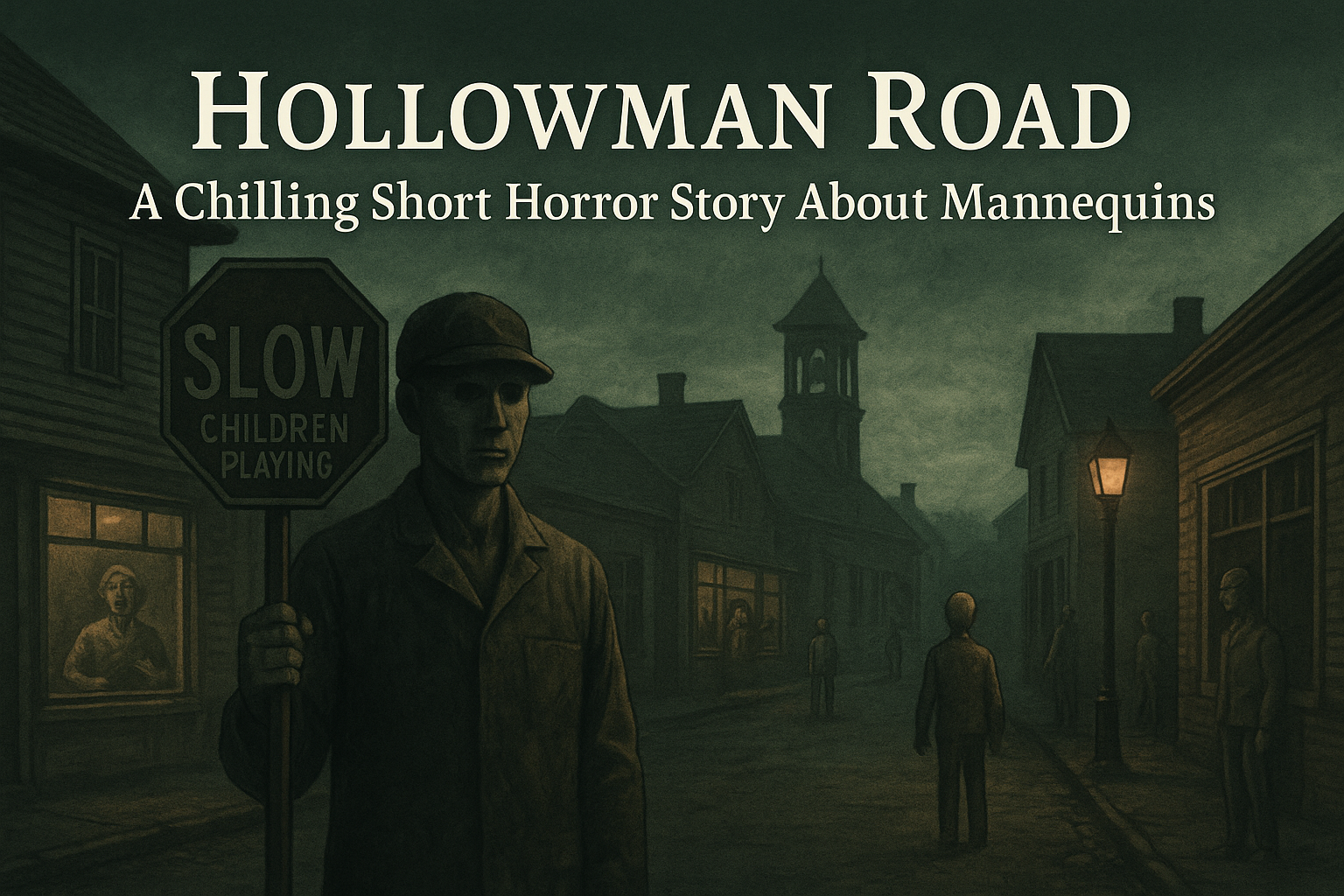
It was a crossing guard mannequin.
Holding a sign that read:
SLOW, CHILDREN PLAYING
And its plastic head… was turned just slightly toward him.
A Town of Plastic and Silence
Henry’s car sputtered and died outside a faded welcome sign half-buried in leaves:
Welcome to Dalton’s Glen – Est. 1896
There were no lights in the houses. No people on porches. Just a creeping stillness that felt too heavy for such a little town.
He stepped out, jacket zipped against the sudden chill, and called out. “Hello? Anyone around?”
Silence.
Then — creak.
A shop door moved slightly in the breeze. Henry pushed it open and stepped inside a barbershop. He froze.
Inside, a barber — plastic, mannequin — stood with razor poised above a seated customer mannequin. Both wore fixed expressions.
Not the friendly, smiling kind.
The kind of expressions people wear in the instant before they scream.
Henry backed out slowly, heart pounding. As he turned the corner, he saw more of them:
-
A woman frozen mid-scream in a diner window.
-
A paperboy mannequin holding out a stack of yellowed news.
-
A cop pulling a gun on a boy with a slingshot — both unmoving.
Every figure in the town was posed, mid-scene. Like someone had paused reality in its most uncomfortable moments.
Where Did the Car Go?
Panicking, Henry bolted back to where his car had died.
But it was gone.
No tire marks. No broken glass. Nothing.
Just four mannequin hands sticking out of the gravel, spaced exactly where the wheels had been.
He staggered back. “No. No, no, no. What the hell is this?”
Then, behind him, the town bell rang. Once. Twice. Echoing like thunder.
The sun slipped behind the hills.
And the mannequins began to move.
The Hollow Come to Life
At first, they didn’t move like people. They jerked, like frames skipping in an old film reel. Their joints clicked. Their heads twitched at angles no neck should allow.
Henry ducked into the nearest building — a church — and slammed the doors shut. Inside, the light from stained glass painted strange colors across rotting pews.
Above the altar, a plaque read:
“Thou Shall Not Blink in the Presence of the Hollow.”
On the lectern, he found a dusty leather-bound diary. The entries were rushed, panicked. They told the story of Dalton’s Glen.
It had once been a mining town. In 1938, the miners had unearthed something they shouldn’t have — a presence, a shapeless intelligence that learned by watching, then by mimicking. First animals. Then people.
The townsfolk called them the Hollow. Beings that didn’t just replace — they recreated. Mannerisms. Expressions. Emotions.
Every person taken was turned into a perfect mannequin… posed forever in their last known feeling.
The preacher’s final entry read:
“They take your form, then your soul. Memory fades. Pose remains. If you see your own face — run. You’re already part of the scene.”
Losing Time, Losing Self
Henry fled the church and found the town changed.
The streets weren’t where they were. The buildings had shifted. Mannequins stood in new positions — watching, waiting.
He saw one that made his knees buckle.
It was himself.
>Same blazer. Same briefcase. Same wide-eyed expression.
Frozen. Mouth open in a silent scream.
The mannequin’s lips moved.
“You’re already part of it.”
Henry stumbled back. His head swam. What was his name again? What did he sell? Had he ever left the road?
That’s when he saw her — a mannequin girl, one arm missing, standing in the shadows. She didn’t move like the others. She raised a finger to her lips. Shhh.
She knelt and wrote in the dust:
“CLOCK TOWER. SUNRISE. ESCAPE.”
The others were coming. Some running. Some crawling. Their movements stuttered. Grotesque.
Henry followed her into the dark.
They Climbed the Stairs
The tower loomed above the square, its clock ticking backward.
They climbed the stairs as the Hollow closed in — dozens of them, expressions frozen in horror or rage. Like mannequins had been staged mid-nightmare.
The top floor was a control room — filled with ropes, pulleys, levers, and lights. A massive spotlight pointed over the town.
This wasn’t a town at all.
It was a set.
A diorama. A stage for performances played eternally for no one.
Henry grabbed an old canister of kerosene and splashed it over the gears.
The mannequins burst through the door, melting now — their features sloughing off like wax. One lunged at him.
He struck a match.
“Curtain’s down,” he said, and threw it.
The flames rose. The clock tower shook.
And for the first time, the clock ticked forward.
The Road Behind
Henry woke in a ditch, choking on smoke and soot.
A truck’s horn blared. “Hey! You okay?”
He looked up. A weathered trucker leaned out the window.
“Looks like you’ve had a rough night, friend.”
Henry climbed in. “I… I think I got lost.”
“Yeah, Hollowman Road’ll do that to you,” the driver said with a smirk. “You’re lucky. Not everyone finds their way out.”
As they pulled away, Henry looked back.
A single plastic hand stuck out of the roadside dirt. Pale. Still.
The driver grinned again. Wider this time.
“Don’t worry,” he said. “No one ever really leaves the stage.”
In the side mirror, Henry caught a glimpse of himself.
He was smiling.
Frozen.
Unmoving.
Plastic eyes shining in the sun.
Final Thoughts on Hollowman Road
If you enjoyed Hollowman Road, share it with fellow horror lovers. Inspired by the unsettling small-town dread of Stephen King and the uncanny terror of being watched, this story taps into the primal fear of losing yourself — literally.