

Hospitals are supposed to be sanctuaries. White walls, sterile instruments and the steady hum of machines are all designed to comfort us with the promise of science and healing. But peel back the antiseptic surface and medical history is just as terrifying as any horror film. Doctors are not always saviors, sometimes they are the monsters.
From crude surgeries in ancient times to twisted experiments in the modern era, the world of medicine has produced real life horrors that would make even the boldest director take pause. The scalpel, after all, can cut in more ways than one.

Ancient Nightmares
The earliest doctors worked with little more than sharp stones and blind faith. Trepanning, one of the oldest recorded surgical procedures, involved drilling or scraping a hole into the skull to release evil spirits said to cause seizures or madness. Imagine the scene: a patient held down by friends or family while a crude flint tool grinds into bone. The victims screamed until they passed out. Archaeologists have uncovered skulls with multiple healed holes, proof that some patients survived the ordeal. Only to be tortured again when their “demons” returned.
Other practices were no less horrific. In ancient Egypt, amputations were performed with bronze knives, wounds cauterized with fire. Infection was almost a guarantee. Without anesthesia, every incision meant agony. In Greece, bloodletting was prescribed for headaches, fevers and even melancholy. Leeches were applied by the handful, sucking until the patient turned pale. The theory was simple: drain the bad blood, drain the sickness. In practice, it left many patients weaker and closer to death than before.
To our eyes, those treatments look barbaric. Yet they were the best answers people had. The horror wasn’t in the procedures themselves but in the desperate hope behind them. The willingness to endure mutilation and torture because the alternative seemed far worse was strong in the ancient mind.
The Age Of Asylums
By the 19th century, medicine had made strides but mental health care remained locked in the shadows. Asylums sprang up across Europe and America. These were places where families sent their troubled relatives and society forgot about them. Behind the barred windows and bolted doors, “treatment” was often indistinguishable from punishment.
Patients were strapped in ice cold baths for hours, sometimes days, their skin would shrivel as they shivered. Others were confined in straightjackets or left in dark, padded cells where silence and isolation was thought to calm the mind. Electrotherapy was introduced – jolts of electrical current meant to shock insanity out of the brain. Early machines had no safeguards and patients were often burned. The voltage even caused some patients to burst into flames. The surviving patients were left with second and third degree burns, broken bones and destroyed brains.
Even the dead weren’t safe. Medical schools, desperate for cadavers to study, turned to graverobbers. Freshly buried bodies were dug up under the cover of night, dissected by medical students the next morning, then discarded either in a river or in a wooded area. Entire neighborhoods near the medical colleges lived in fear of the “resurrection men” who plundered their cemeteries. The line between doctor and ghoul blurred and the public began to see some schools of medicine as a dark art, one step removed from graveyard stories.
It is no accident that Mary Shelley’s Frankenstein (1818) was born in this era. The novel’s stitched together monster was not fantasy but a reflection of real anxieties, that science, left unchecked, would desecrate bodies and souls alike in the pursuit of knowledge.
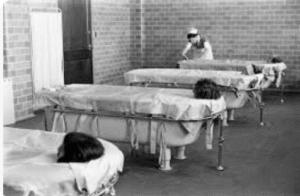
Dr. Walter Freeman – The Lobotomy King
If the asylum era blurred the lines between care and cruelty, Dr. Freeman erased it entirely. In mid-20th century America, Freeman championed the lobotomy as a miracle cure for everything from depression to schizophrenia to disruptive behavior. The procedure itself was shockingly crude: an ice pick lid through the eye socket, a hammer tapping it into the brain and a quick sweep to sever the frontal lobes.
Freedman turned the operation into theater. He toured the country in his so-called “lobotomobile” performing demonstrations before packed houses. Sometimes, he lobotomized multiple patients in rapid succession, boasting how quickly he could transform lives. He carried two picks so he could operate on both eyes at the same time, his hands working with the casual flair of a man peeling an egg.
The results were grotesque. Some patients emerged compliant but child-like, stripped of ambition, creativity and the ability to care for themselves. Others suffered seizures, incontinence or violent mood swings. Many died. Freedman kept few records of the failures, preferring to spotlight his “successes.” Families who entrusted their loved ones to his scalpel often got strangers in return, hollow eyed shells that just stared blankly at the world.
By the time the medical establishment turned on him, Freedman had performed over 4,000 lobotomies. Ever the showman he was proud of his work until the end. His legacy is a chilling reminder that horror does not always wear a mask or wield a knife. Sometimes it smiles behind a white coat.
Dr. Shiro Ishii – The Butcher Of Unit 731
If Freedman embodied the arrogance and ego of medical ambition, Dr. Ishii represented something far darker. He was sadism disguised as science. During WWII, Ishii oversaw Japan’s Unit 731, a secret biological warfare program in occupied Manchuria. Officially, it was a research facility. In reality, it was a slaughterhouse.
Prisoners, known as “logs” to their captors were subjected to experiments designed to push the limits of human suffering. Some were dosed with Bubonic Plague, others with Cholera, Syphilis, or Anthrax and then dissected alive to chart the course of the disease. Others were frozen alive until their limbs turned black from frostbite, then thawed to study tissue decay. Exploratory surgeries were performed without anesthesia so doctors could observe organs functioning in real time. Women were raped to study the transmission of venereal disease. Infants were starved, injected, frozen and exposed to chemicals. All while being studied like lab rats. He was what Dr. Josef Mengele was to Nazi Germany but shielded by the cloak of Communism.
The true horror came after the war. Ishii and many of his staff were never prosecuted. Instead, the US government struck a deal: immunity for exchange of their data, which was deemed too valuable to waste. He lived out his life in comfort, unpunished. His crimes were buried under the bureaucracy of war.
In horror fiction, the mad scientist often meets poetic justice. Maybe devoured by his own creation or torn apart by the forces he unleashed. But in Ishii’s case, he walked free. Justice not being served is possibly the most terrifying of all.
Medicine In Horror Media
It’s no coincidence that horror fiction so often finds inspiration in asylums, hospitals and laboratories. These are places where the body is exposed. Vulnerable. Helpless. In the wrong hands a scalpel can be a lethal weapon.
Mary Shelley’s Frankenstein gave us the archetype scientist playing god, stitching life into death. Later films like Re Animator (1985) and Frankenstein’s Army (2014) reveled in grotesque surgical nightmares. David Cronenberg turned the operating theater into a stage for body horror, exploring the terror of flesh transformed. American Mary (2012) examined surgical obsession and revenge, while Session 9 (2001) and American Horror Story: Asylum (2012) drew directly from the haunted legacy of mental institutions.
The recurring theme is trust betrayed. Doctors are supposed to heal us. When they harm instead, the violation is intimate. Horror exploits that primal fear, showing us what happens when the healer becomes the executioner.

Conclusion – The Doctor Will Kill You Now
The true terror of medical horror lies not in shadows and superstitions, but in trust. We submit to doctors willingly. Baring our bodies. Surrendering our consciousness and placing our lives in their hands. History has shown how fragile that trust can be.
From ancient trepanning to Freedman’s ice pick, from Ishii’s vivisections to the grotesque history of asylums, the line between healing and horror is razor thin. Medicine has given us miracles, yes – vaccines, life saving surgeries and cures but it has also given us monsters in white costs. Men whose curiosity or cruelty left trails of corpses behind them. So the next time you are under those fluorescent bulbs in the examination room, remember the doctor’s tools are sharp and not every cut is meant to heal.