

The desert winds whisper through the crumbling ruins of ancient tombs, carrying with them a warning that has endured for millennia: disturb the sleep of Egypt’s dead, and you invite their wrath. The Curse of the Pharaohs is more than a tale of superstition—it is a chilling intersection of myth, history, and unexplained terror that has haunted both archaeologists and storytellers alike.
The Roots of the Curse
Ancient Egypt was a civilization obsessed with death—and more importantly, the afterlife. The Egyptians believed that preserving the body through mummification, surrounding it with treasures, and sealing it within sacred tombs ensured safe passage to eternity. Pharaohs, who were considered divine rulers, were buried with unimaginable riches, amulets, and texts such as the Book of the Dead—all designed to protect their souls against evil forces and guide them in the afterlife.
But those protections did not stop at magical spells or golden charms. Inscribed on some tomb walls were ominous warnings—curses meant to deter thieves and intruders. One chilling inscription reportedly read:
“Death shall come on swift wings to him who disturbs the peace of the king.”
These curses reflected a very real fear. Tombs were vulnerable to looting, and desecration of the dead was seen not only as sacrilege but also as a disruption to cosmic order (Ma’at). Whether supernatural or psychological, the threat of a curse was a powerful deterrent.

Spirits and Ancient Evils
Egyptian mythology teemed with deities and spirits that blurred the line between protection and vengeance. Gods like Anubis, the jackal-headed guardian of the dead, watched over tombs, punishing those who dared trespass. Meanwhile, restless spirits known as Akh could manifest from improperly buried individuals or those disturbed in death. The Akh were said to torment the living with madness, misfortune, or disease—an idea that easily fused with the notion of tomb curses.
The pharaohs themselves, embalmed and entombed with divine reverence, were not imagined as passive corpses. Many believed their spirits lingered, empowered by protective spells carved into their resting places. To trespass was not merely to steal gold, but to rouse an ancient and angry power.
The Death of Lord Carnarvon – A Real-Life Curse?
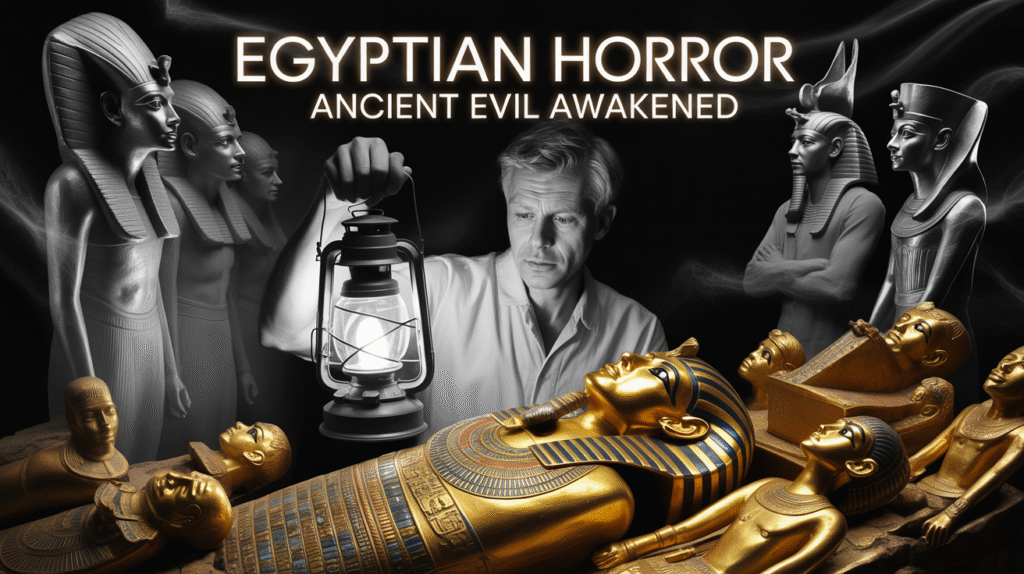
No story captures the menace of the Pharaoh’s curse like the tale of Tutankhamun’s tomb. In 1922, British archaeologist Howard Carter made history by unsealing the boy king’s burial chamber in the Valley of the Kings. The discovery was hailed as the greatest archaeological find of the century. But celebration quickly turned to unease.
Soon after the tomb’s opening, Lord Carnarvon—the expedition’s financial backer—died suddenly of blood poisoning from a mosquito bite. Newspapers pounced on the tragedy, framing it as proof of a curse. Even stranger, legend spread that at the moment of his death, lights in Cairo mysteriously went out, and his dog back in England howled before collapsing dead.
Others connected subsequent deaths of people linked to the tomb with the curse. Although Carter himself lived for many years afterward, the narrative had already taken root in the public imagination: the pharaoh’s wrath had been unleashed upon those who dared disturb his eternal rest.
The Curse in Modern Horror and Pop Culture
The Curse of the Pharaohs has seeped deeply into modern horror. From Universal’s The Mummy (1932) and its later remakes to Hammer Horror films and even Brendan Fraser’s The Mummy (1999), the trope of the resurrected Egyptian corpse seeking vengeance remains a cinematic staple. These movies may exaggerate the myth with shuffling bandaged monsters or armies of sandstorms, but at their core, they play on the same fear that haunted ancient tomb robbers: the dead do not forgive intrusion.
Literature, too, has embraced the theme. Gothic stories of cursed mummies and vengeful pharaohs filled Victorian magazines, while horror writers like Bram Stoker experimented with Egyptian curses in works such as The Jewel of Seven Stars. Video games, comics, and TV shows continue the tradition, often blending archaeology with supernatural horror, cementing the pharaoh’s curse as one of the most enduring legends of ancient evil.
Why the Legend Endures
For Egyptians of the past, the curse was more than a ghost story—it was a cultural safeguard, reinforcing respect for the sanctity of the dead. To desecrate a tomb was not just theft, but a violation of divine order. The legend taught that arrogance and greed would be punished, whether by mortal hands, disease, or the supernatural.
For us today, the horror lies in something deeper. Tomb curses remind us of the fragility of human power when confronted with time and eternity. In a world obsessed with conquering history and uncovering secrets, the Pharaoh’s curse whispers that some mysteries are not meant to be touched.
Closing Shadows
Imagine standing in a pitch-dark burial chamber, the air heavy with centuries of silence, the painted eyes of gods staring down from the walls. The smell of dust and ancient resin fills your lungs. You feel the stillness pressing in around you, and yet—something lingers. Perhaps it’s only your heartbeat echoing in your ears. Or perhaps it’s the Pharaoh, watching, waiting, ready to remind you that the dead are never truly powerless.