
“What is life without honor? Nothing.” Gavrilo Princip
History is not written by kings or generals, it is interrupted, often violently, by assassins. A single pistol shot, a carefully drawn blade or a well laid bomb can derail empires, destroy leaders and set nations ablaze. Political assassins are not common killers. They are men driven by ideology, hate or desperate visions of freedom. Yet their acts rarely liberate anyone. Instead, they leave chaos, grief and blood soaked pages in history’s ledger.
In the chapter we examine two assassins, separated by continents and time. Gavrilo Princip, the frail student whose bullets in Sarajevo helped trigger World War One, and John Wilkes Booth, the American actor who gunned down Abraham Lincoln in the twilight of the American Civil War. Both men convinced themselves that they were striking blows for glory. Both became remembered as murderers who changed history forever.
Gavrilo Princip – The Shot That Shook The World
Born in 1894 in the rugged countryside of Bosnia, Gavrilo Princip grew up the son of peasants under Austro-Hungarian rule. Sickly, underfed and perpetually resentful, he carried a chip on his shoulder the size of an empire. In Sarajevo he found direction in Young Bosnia, a group of radical students preaching revolution and South Slavic unity. But youthful idealism quickly turned into fanaticism when Princip fell into the orbit of The Black Hand, a shadowy Serbian nationalist organization that was willing to achieve its goals through blood.
The Archduke Franz Ferdinand, heir to the Austro-Hungarian throne, planned a tour of Sarajevo on June 28, 1914, a date laced with symbolism. For Serbs, it was the anniversary of the battle of Kosovo, a centuries old wound. For Princip and his comrades, it was the perfect opportunity. They armed themselves with pistols, grenades and cyanide pills, fully prepared to kill or die for their cause.
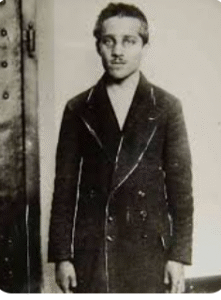
The plan nearly unraveled immediately. One conspirator hurled a bomb but it bounced off the Archduke’s car and exploded under the next vehicle. Civilians were killed and maimed, the convoy sped off. Princip wandered the streets in despair, certain their mission had failed. Yet fate or blind chance had other plans. Later that morning the Archduke’s driver took a wrong turn and stalled right outside of the cafe where Princip was sipping coffee on the patio.
Seizing the moment, the frail young man fired two bullets at point blank range. Franz Ferdinand was struck in the neck and his wife, Sophie, in the abdomen. Both died moments later on the backseat of their car soaked in blood. Princip’s cyanide capsule failed to work and he was beaten nearly to death by an enraged mob before the police took him away.
At his trial, Princip claimed he was fighting for the liberation of his country, not to ignite a world war. Yet this is precisely what happened. Austria-Hungary declared war on Serbia. Alliances, imperialism, militarism and nationalism activated like falling dominoes. The tensions had been escalating for years and within weeks the world was engulfed in a conflict that would kill millions. Princip, too young to be executed, rotted in prison. Tuberculosis consumed him, he had lost an arm to infection and died at the age of 23 in 1918, a frail and broken man.
He dreamed of glory but only left behind carnage. His two bullets opened the bloodiest century the world has ever known.
John Wilkes Booth – The Actor Turned Assassin
If Princip was a feeble peasant boy, John Wilkes Booth was his polar opposite. He was wealthy, handsome and celebrated. Born in 1838 into America’s most famous theatrical family, Booth was the matinee idol of the day. Women adored him, critics praised him and audiences filled theaters when he performed. But beneath the glamour was a man consumed by politics and poisoned by hate.
Booth was a rabid supporter of the Confederacy during the American Civil War. He despised Abraham Lincoln with a burning obsession, calling him a tyrant and the destroyer of the South. In the war’s final months, Booth hatched schemes to kidnap the president and ransom him for Confederate prisoners of war. But with Lee’s surrender in 1865, his radical fanaticism deepened. If the Confederacy was dead, Booth would avenge it with blood.
On the evening of April 14, Lincoln and his wife attended a performance of Our American Cousin at Ford’s Theater. Booth, ultimately being familiar with the building, planned every detail. Around 10:15 he creeped into the presidential box, pressed a small Derringer pistol to the back of Lincoln’s head and fired. The president slumped forward, mortally wounded.
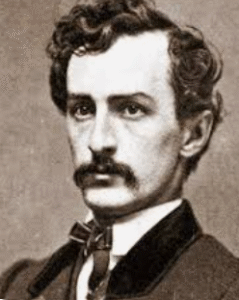
Leaping from the stage, Booth brandished a knife and shouted, “Sic semper tyrannis” – “Thus always to tyrants” before fleeing. In the chaos, he slashed a Union officer that tried to stop him and bolted into the Washington night. His leap had broken his leg but adrenaline pushed him forward. For twelve tense days, Booth and an accomplice, Dave Herold, evaded capture across Maryland and Virginia, aided by Southern sympathizers.
The manhunt ended at a tobacco barn in Port Royal, Virginia. Union soldiers surrounded the fugitives, demanding surrender. Booth refused. The barn was set ablaze and as the flames lit the night a soldier’s bullet hit Booth in the neck. Dragged out, paralyzed and gasping for life, Booth’s final words were reported as, “Tell my mother I died for my country.” He bled out convinced of his own martyrdom.
History did not oblige him. Instead of a Southern hero, Booth became a national villain. He will be remembered as the man who shot and killed Abraham Lincoln at a time when our nation was ready to heal. Like Princip, he hoped for glory but left only ruin.
Two Others Worth Mentioning
Nathuram Godse and Ghandi
On January 30, 1948, Nathuram Godse approached Mahatma Gandhi during a prayer meeting in New Delhi and shot him three times at point blank range. A Hindu nationalist, Godse believed Gandhi had betrayed India by showing too much leniency toward Muslims in the wake of Partition. Gandhi’s death not only silenced one of the greatest voices for nonviolence that the world had ever known. It also showed deep fractures of religious and political identity still tearing at the nation.
Lee Harvey Oswald and Kennedy
On November 22, 1963, President John F. Kennedy was struck down in Dallas, Texas by gunfire while riding in his motorcade. The accused assassin, Lee Harvey Oswald, was a former Marine with pro-Soviet sympathies who had once defected to the USSR. Oswald never stood trial, he was shot and killed two days later by nightclub owner Jack Ruby. But Oswald’s role in the assaination has sparked decades of speculation and conspiracy theories that persist to this day. Kennedy’s assasination remains one of the most studied crimes in the annals of American crime history. It’s emblematic of how one act of violence can fracture a nation’s trust in its government.
Conclusion
From Princip’s bullets in Sarajevo to Booth’s shot at Lincoln, from Gandhi’s killer to Oswald, history shows how individual men, often driven by ideology, delusion and rage can change the path of a nation. Assassination is the ultimate act of political violence, silencing leaders and igniting movements, wars and revolutions in their wake. The figures explored here remind us that power, once concentrated in the body of a single leader, is always vulnerable to a gunman with a cause.
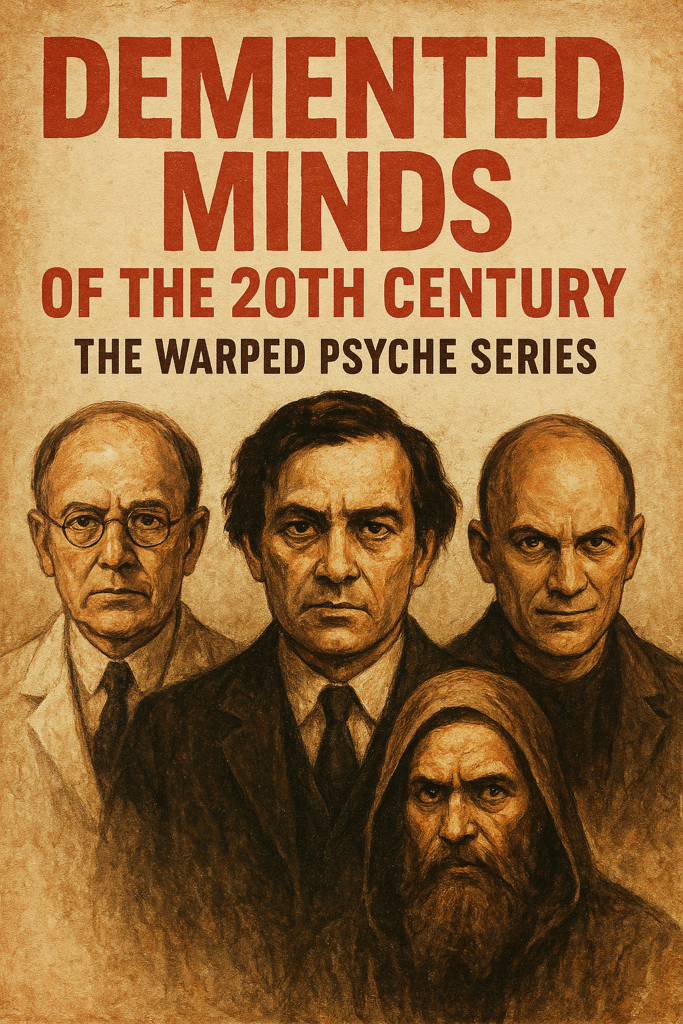
So with this final chapter, we close the Demented Minds series. From serial killers to cult leaders to mad doctors and political assassins, this journey has peeled back the curtain on some of the darkest corners of human history. Thank you for walking through it, for staring into the abyss alongside me and not looking away. The stories have been grim, grotesque at times but always revealing of what human beings are capable of when their minds twist beyond reason.