

A journey into the minds of the disturbed, the delusional and the damned
This series delves into the darkest corners of the human mind, not just the violence committed. But the obsession, delusions and twisted identities that shaped each. Each article explores a different category of disturbed individuals: cult leaders, mad scientists, medical murderers, political sadists and young psychopaths. These aren’t just profiles into the demented, they are autopsies of belief, power and mental collapse. Through testimony, history, psychology and the chilling facts left behind, we examine what happens when the mind turns inward, and drags others down with it.
When God Wore A Human Face
“He wasn’t God. He just knew how to act like him.”
They didn’t stalk in the shadows or hide behind masks. These killers stood in the open, behind pulpits, seated in circles of candlelight or speaking through grainy VHS tapes in calm, measured tones. They smiled. They preached peace, purity, enlightenment and acceptance.
Then, they told people to die.
The 20th century was not only the age of serial killers, it was the golden age of psychological mind control. From the jungles of Guyana to the suburbs of California, ordinary men declared themselves messiahs, prophets and saviors. They promised a better world, a coming apocalypse or spiritual rebirth. Their followers, desperate for meaning, followed them into madness.
Some called it faith. Some called it family but history would call it murder.
What makes a man believe he is God? What makes hundreds, even thousands surrender everything, including their lives to a single voice? This article explores the warped psyche of modern cult leaders. Men whose delusions grew so powerful that it consumed entire communities.
They didn’t just kill. They converted. They brainwashed and erased identities and then they commanded death.
These are the Messiahs of Madness.
Jim Jones – The Prophet Of Poison
How one man turned a promise of equality into a jungle of death.
Before the plastic cups of cyanide and Flavor-Aid, before the jungle compound and the mass grave, Jim Jones was a boy with a bible in one hand and a morbid fascination with death in the other. Raised in rural Indiana in the 1930s and ‘40s, Jones was odd even as a child. Neighbors recalled how he would hold funerals for road kill and preach to the empty fields. The trees were his congregation for the fire and brimstone services.
Although strange, he was charismatic, almost magnetic. But beneath the surface lurked something far more colder. The need to control. To dominate. To be worshipped and to dictate life and death.
In the 1950s, Jones began cultivating his first congregation in Indianapolis. It was progressive, interracial and socially conscious. The kind of church that seemed decades before its time. He called it “The People’s Temple.” It attracted those that hungered for change. Jones adopted children of many different races calling it his “Rainbow Family.” He denounced racism from the pulpit. He fed the poor, housed the homeless. He gave people hope and although he never marched alongside prominent civil rights leaders of the time, he championed racial equality and social justice.
But his image of a revolutionary pastor hid something far more dangerous.
Jones was obsessed with loyalty. Not just faith but total allegiance. He required his followers to call him “Father”. He planted rumors of enemies plotting against them, mainly the American FBI. He staged “miracles”, fake healings to prove his divine power. He even faked being shot and killed only to say he had the power of “resurrection like Christ himself”. Those who doubted were shamed, beaten or cast out. He created an “us vs them” narrative that would become the blueprint for cult behavior. The world outside is evil, only I can save you and if I fall, we all fall.
As government and media scrutiny grew, Jones claimed America was no longer safe for his flock. He preached that the CIA was going to send assassins. He ranted about a nuclear holocaust, the fall of Western civilization and WWIII. In 1977 he led hundreds of his followers deep into the South American jungle to a patch of land in Guyana. He called it Jonestown. He said it was paradise, it would become a graveyard.
The Road To Ruin, From People’s Temple to Jonestown
By the mid 1970s, Jim Jones had grown far beyond the charismatic storefront preacher of Indianapolis. He was now a self-styled prophet with thousands of devoted followers and a growing appetite for drugs and control. His sermons, once rooted in equality and social justice, now bled into paranoia, surveillance and totalitarian rhetoric. What began as a progressive church offering racial integration, free meals and housing for the needy soon twisted into something unrecognizable.
Jones moved his people to California, first to Redwood Valley then to San Francisco and Los Angeles. There, his influence deepened. Politicians courted him, journalists hesitated to criticize him and his congregation swelled. But as defections increased and whispers of abuse and fraud mounted, Jones became increasingly unstable. He had grown addicted to drugs and power in equal measure. He was reportedly addicted to a dangerous cocktail of barbiturates, amphetamines and tranquilizers. This mix only fueled his paranoia, amplified his mood swings and left him teetering between delusional grandeur and violent outbursts.
The picturesque utopia in Guyana, that Jones promised, was the answer.
Life in Jonestown was far from idyllic. Armed guards patrolled the perimeter, telling parishioners it was for wild jungle animals. Jones would censor all letters, fueling his paranoia. Any criticism or unkind word found would result in the writer being harshly punished. The food was scarce, rice and gravy – three meals a day. Work days were grueling, twelve hours of hard labor in the Guyanese sun. Working fields, chopping wood, preparing food, repairing infrastructure. The jungle was brutal and sleep was rare. Jones preached for hours over loudspeakers, his voice omnipresent. Dissenters were publicly shamed, punished or simply vanished. Families were torn apart, children were indoctrinated and any hope of escape was extinguished by fear.
Then came Congressman Leo Ryan and the Concerned Relatives Group.
In November 1978, Ryan flew to Guyana with journalists and the Concerned Relatives Group along with family members to investigate reports of abuse. At first, the visit seemed inviting and welcoming, Jones staged performances, children sang and members offered rehearsed praise. Survivors recall the meal that was served that evening was unlike anything they had seen in a very long time. Meat, potatoes, dessert and of course, Flavor-Aid. But when a handful asked to leave with the Congressman and his party. Jones’ mask began to slip.
As Ryan and his group prepared to depart, they were ambushed at the Port Katmai airstrip. Gunmen from Jonestown came speeding onto the runway, their truck barely stopping before they opened fire. Spraying the dusty airstrip with bullets, hitting several defectors and members of the press corps. Ryan was shot dead along with Don Harris, an NBC correspondent, and Bob Brown, an NBC camera man. Bob Brown’s camera continued to record after he had fallen. He recorded the gunmen walking through the wounded and executing them. Greg Robinson a photographer from The San Francisco Examiner and Patricia Parks a defector were also killed. The jungle seemed to hold its breath.
Back at the compound, Jones called for his “white night” or revolutionary suicide. As audio recordings would later reveal, his voice was calm. Soothing. Coaxing. Almost fatherly. Under the command of a man unraveling at the seams, nearly a thousand people, many of them children, were forced to drink a grape flavored drink laced with cyanide, valium and chloral hydrate. Despite common myth, the drink was not Kool-Aid but a cheaper knock-off called Flavor-Aid. Cyanide poisoning is a brutal, agonizing death – convulsions, foaming at the mouth, difficulty breathing once the lungs fill up, seizures and cardiac arrest. Parents administered the poison to their children first, most having it pushed into their mouths with syringes. The air filled with screams, sobbing and the every present voice of Jim Jones.
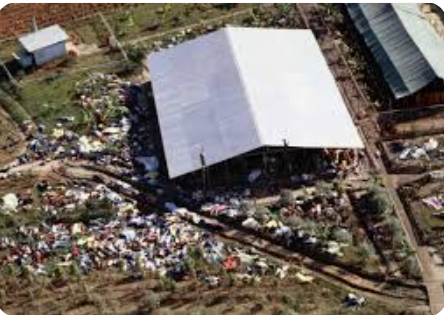
Bodies piled up in rows under the sweltering Guyanese sun, they had fallen holding each other, laying down to die arm in arm. Some were embracing, others hand in hand, all dead from Cyanide. Jim Jones, ever the coward, chose to not follow his flock into death by poison. Instead, he died from a gunshot wound, likely given to him by his nurse, Ann Elizabeth Moore. They were the only two among the poisoned dead that died from gunshot wounds. His final act wasn’t one of martyrdom but of evasion. The so-called prophet who had preached revolutionary suicide could not bear to face the very death he demanded of others.
When Guyanese officials arrived, they found 918 bodies, 300 of them children, scattered in rows like a human harvest. One investigator stated that it didn’t seem real, from the helicopter it looked like colored confetti on the ground. It was the largest single loss of American civilian lives in a deliberate act until 9/11.

The Second Coming – David Koresh and The Siege At Waco
The Making Of A Messiah
Born Vernon Wayne Howell in 1959, Koresh came from troubled beginnings. Raised in Texas by his teenage mother and later his grandmother, he struggled with learning disabilities. He dropped out of school and lived a largely isolated existence. But by his late teens, he developed an intense fascination with the bible. He was particularly drawn to Revelation, Daniel and several other chapters and verses, the end of times. Something that would define his life.
In the early 1980s, he joined the Branch Davidians, a small apocalyptic sect outside of Waco, Texas. With his knowledge of scripture and his charismatic nature he rose quickly through the ranks. He claimed to have visions from God and became romantically involved with the sect’s aging prophetess, Lois Roden. After her death, Koresh clashed with her son for control of the compound, eventually winning over the majority of the group. He changed his name to David Koresh, linking himself to King David and the Persian liberator Cyrus. He declared he was the lamb of God and was chosen to interpret the book of Revelation.
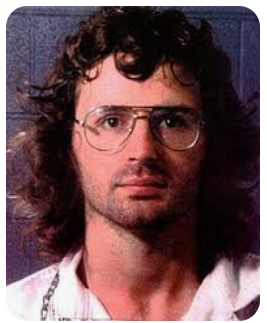
Koresh transformed Mount Carmel into a compound of complete devotion. He broke up marriages. Took “spiritual wives,” some underage, and preached that he alone could father the children of the kingdom to come. His teaching centered on apocalyptic war, a coming siege and the idea that he and his followers would face violent persecution at the hands of the government. As he amassed weapons and stockpiled supplies, Koresh preached that the end was near. For federal agents watching from the outside, the rhetoric sounded less like religious preachings and more like an armed standoff ready to ignite.
By the 1990s, Koresh’s compound had drawn the attention of federal authorities. The ATF secured a federal search warrant for automatic weapons and an arrest warrant for Koresh. Agents began monitoring the Mount Carmel Center from a distance, watching the activity and gathering intelligence. What began as a standard weapons investigation would soon spiral into one of the most infamous and tragic standoffs in American history.
The Siege Begins
By the time federal agents surrounded Mount Carmel on February 28, 1993, David Koresh’s psychological state was already beginning to slip. As negotiators pleaded for a peaceful solution, Koresh responded, not with cooperation but with scripture. He believed the standoff was not a law enforcement operation but a fulfillment of his own prophecy.
Despite being wounded in the initial exchange of gunfire, Koresh refused to surrender. Instead, he delivered long, erratic sermons over the phone, recorded for federal agents. In his feverish voice, he spoke of seals being broken and final judgments coming to pass. Each passing day seemed to inflate his sense of divine authority. He told his followers that they were soldiers in a holy war and that death, if it came, would be a gateway to eternal salvation.
Inside the compound, food supplies were dwindling. As a result the children were kept separately and fed minimal rations while the adults had to listen to Koresh’s rambling sermons, sometimes for hours at a time. Outside federal agents struggled to decipher his incoherent tirades and keep negotiations open. But Koresh’s goalposts shifted constantly. One moment he would agree to surrender after finishing the written version of his revelation. Next he claimed that God told him to wait.
As the 51 day siege wore on, it was clear that David Koresh had no intention of coming out alive. He spoke of martyrdom for himself and his followers. The man who once claimed to be a messenger of peace had become a self proclaimed messiah in a war against a godless government. He was trapped in a world of paranoia, prophecy and power.
Inferno At Mount Carmel
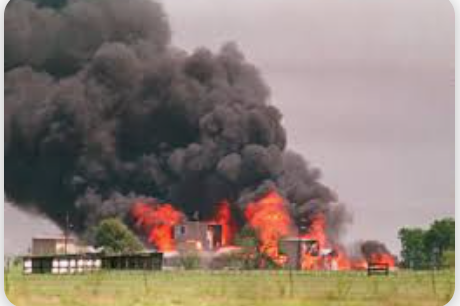
On April 19, 1993, the FBI initiated the final assault, pumping tear gas into the compound. For hours, loud speaks blared, armored vehicles smashed through walls and gas filled every corner of the building. Negotiators believed the Branch Davidians would surrender once overcome, but no one emerged. Shortly after noon, fires erupted from within. The source of the blaze is still highly debated, whether intentionally set by the Davidians or caused by the chaos of the raid, but the flames spread fast through the wooden structure. It was accelerated by high winds and the flammable materials stockpiled inside.
Inside, there was no escape. Many were trapped in windowless bunkers and buried beneath barricaded doors. Koresh himself did not burn to death. His body was later found with a fatal gunshot wound to the forehead. Suggesting he was either shot by one of his flock or he took his own life rather than face capture. Alongside him lay the body of his best lieutenant, Steve Schneider, also dead from a gunshot wound. In total, seventy-six people perished that day, men, women and children. Some from smoke inhalation, others from flames and a few execution style gunshot wounds as an act of a final, twisted salvation.
In the smoldering aftermath, federal agents recovered an extensive cache of weapons, over 300 firearms, including modified automatic weapons, thousands of rounds of ammunition, grenades and parts for silencers. Among the ashes were also video recordings of Koresh’s ranting sermons outlining his plans for the final battle with evil. What remained wasn’t just evidence of a cult’s apocalyptic beliefs but the tragic consequence of one man’s delusion taken to a horrific end.
The fallout from Waco didn’t end with the fire. For many Americans, especially those in the militia and survivalist circles, the siege represented a brutal overreach of federal power. The image of tanks rolling toward a religious compound. The flames. The lives ruined within. It became fuel for anti-government extremism. One man in particular, Timothy McVeigh, watched while on scene with simmering rage. Exactly two years later on April 19, 1995, McVeigh detonated a bomb outside the Alfred P. Murrah Federal Building in Oklahoma City, Oklahoma, killing 168 people in what remains the deadliest act of domestic terrorism in US history. In his mind it was revenge for Waco. A twisted act born of an already twisted tragedy.
Conclusion: Echoes of Delusion and Devotion
The stories of Jim Jones and David Koresh are not merely cautionary tales. They are grim reminders of how charisma, desperation and unshakable belief can spiral out of control and into collective catastrophe. Both men claimed divine authority. Both offered their followers promises of safety, salvation or spiritual rebirth. Both led them into the fire, both figuratively and literally.
But they were not alone. History is littered with the names of self-proclaimed messiahs. Charles Manson, whose “Helter Skelter” prophecy inspired brutal murder. Marshall Applewhite, who convinced his followers to die for a spaceship hidden behind a comet. Shoko Asahara, the blind guru who orchestrated a Sarin gas attack in the subway of Tokyo, believing it would usher in the apocalypse. Each of them built a world around their warped interpretations of religion. Each wielded absolute control and each left destruction in their wake.
The line between faith and fanaticism is perilously thin. When a single voice becomes gospel, when questioning becomes forbidden and when voices become scared, the result is rarely redemption. It is often a road to ruin. These messiahs of madness remind us that the most terrifying force is not always external. Sometimes it speaks softly, carries scripture and promises paradise. Before leading its followers straight to Hell.