

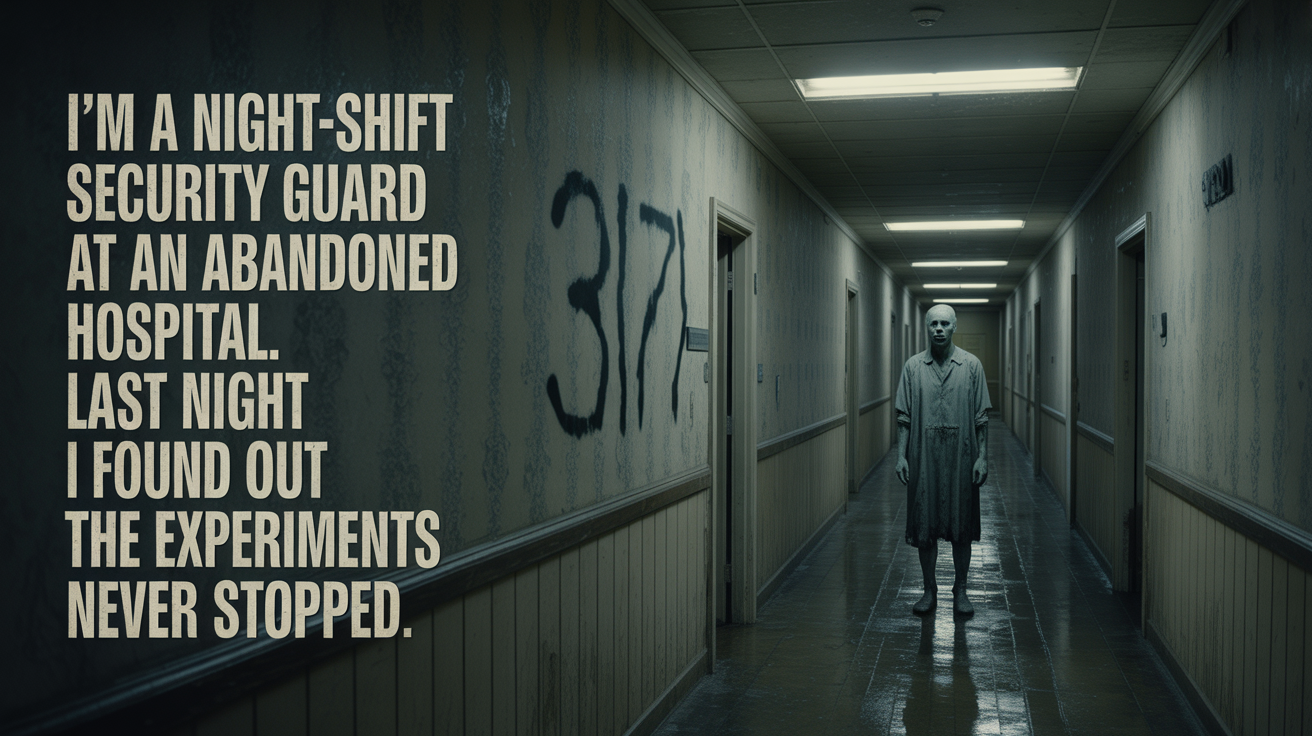
I’m a night-shift security guard at an abandoned hospital. Last night I found out the experiments never stopped.
I take the job because Rich swears it’s easy money. Sit in a windowless control room, watch old cameras, don’t open the doors for anyone. He’s out sick with the kind of flu that keeps you on the bathroom floor, so I cover his shift. One night. I tell my girlfriend I’ll text when I get bored and she sends a thumbs-up and a skull.
Mercy General sits where the city runs out and weeds take over. The parking lot is cracked like dry skin, with saplings growing through the lines. The air smells like rain and old pennies. Inside, the foyer’s a mouth with its teeth pulled: reception desk stripped, vending machines unplugged, a directory board with little plastic letters scattered on the floor like a cheap ransom note.
The control room is a cinderblock cube behind a magnet-locked door. It hums with ancient electronics. Twelve monitors show different parts of the hospital: a hallway lined with room numbers, a stairwell with a handrail worn down to bare metal, the trauma bay that looks like a stage after the show closed and everyone just left their props where they fell. I’ve got a space heater, a coffee maker, and a clipboard with “INCIDENT LOG” typed across the top.
Rich’s only instructions over the phone: “If you hear anything, don’t go wandering. Just call it in.”
“Call who?” I ask.
He hangs up. I tell myself he’s feverish and dramatic.
The first hour is nothing but settling sounds: pipes ticking, wind working the cracked seals. The lights are on a motion sensor and they strobe in empty rooms when the building breathes. I write down the time, because having a pen in my hand makes me feel like I’m doing something useful. 10:08 PM – RAIN STARTS. 10:54 PM – MOTION IN LOBBY (WIND?). 11:13 PM – COFFEE BAD.
At 11:27, Camera 6 twitches. Third floor, east wing. The hallway is empty, then not. Something moves in that jittery, interlaced way old cameras catch motion—just enough to trip your eyes. A shape at the far end passes from right to left. It’s tall. Not a raccoon. Not a homeless guy. I freeze and jab my finger at the switcher, cycling through views. Stairwell. Empty. Elevator, doors yawning open to shaft blackness. Empty.
Back to Camera 6: a door is shut now. Room 317. I stare at it. The door wasn’t shut before. I know it because the busted hinge used to gape like a broken knee.
I get up and check the dusty blueprint tacked to the wall. “3rd Floor – East.” The rooms go 315, 316… skip. 318, 319. No 317. Who takes a room off a map?
The rain picks up. It sounds like applause from a long way off.
On Camera 6, something leans into frame. Not a person. It has the right number of parts—head, shoulders—but the edges are too neat, like it was cut out of something else and stuck here. Skin glossed like freezer frost. It turns its head toward the lens and opens its mouth. It doesn’t scream. It’s worse. It holds it open until the camera fuzzes, like the old TV trick where a singer hits a note and makes the glass tremble.
The entire grid of monitors goes black. The lights wheeze, then die. For a second I hear the hospital naked: rain chewing the roof, a squeak that might be a gurney wheel rolling one inch. Then the generator coughs to life. The fluorescents flick back with a migraine buzz. The monitors return like eyes waking up—except Camera 6 stays black. “NO SIGNAL” floats across it in cheerful white.
Something knocks on the control room door. Three slow knocks, like it’s counting with me.
I don’t breathe. I stare at the little wire-glass window and see nothing. I don’t go to the door. I remember Rich’s voice: don’t go wandering. My thumb hovers over my phone. If I call 911 and tell them an abandoned hospital knocked, they’ll put me on hold and ask me if I’m safe.
The wall clock says 11:46. I blink. It says 3:58. My stomach lurches like an elevator starting. I don’t remember the in-between. My coffee is cold and there’s a fresh line on the log in my own handwriting: 1:12 AM – DO NOT ACKNOWLEDGE. The ink’s smeared like I wrote it fast.
Do not acknowledge what?
When Rich calls at dawn, his voice is steady in a way that feels practiced. “Good. You stayed the whole night. That means you’re cleared.”
“Cleared for what?”
“You’ll see tonight.” He hangs up. I stare at the dead phone. I look at the assignment sheet tacked to the corkboard. My name is printed in permanent marker for the next two weeks. Rich’s name has been peeled off so carefully that I can still see the rectangle of clean cork where it used to be.
I go home, shower until the water runs cold, sleep until afternoon. I dream of sliding doors that never open all the way.
When I come back the second night, something’s changed and I can’t name it. The air is colder, like the building has decided to keep what it has. There’s a laminated card on the control room desk I swear wasn’t there before. MERCY GENERAL – NIGHT OPERATIONAL PROTOCOL. Five rules, typed in a font that tries too hard to be calm:
-
Do not answer the PA after 2:17 AM.
-
Do not look at reflective surfaces longer than three seconds.
-
Do not assist with Rounds. You are not clinical staff.
-
Keep doors closed if they are already closed.
-
If you feel watched, sit very still. It will pass.
The back has a line for a signature. Mine is already there in my handwriting.
“Very funny,” I say out loud, like someone’s here to hear it.
Rain again. The kind that bounces. The kind that makes parking lot puddles blink in the security floodlights like eyes squeezing shut.
Midnight to one creeps by. At 1:09, the PA crackles with machine phlegm. A woman’s voice, flat and old like a recording: “Consent forms incomplete. Subjects must not leave preoperative.
I pick up the phone, then put it down. Rule 1. The clock ticks so loud I could count it with my teeth.
Camera 3—trauma bay—shows a cart that wasn’t there earlier. Stainless steel. Fresh, if that makes sense in here. It reflects the overhead light in a way that looks wet. Something sits on the lower shelf, a bag of dark fluid hooked up to thin tubing. The tubing disappears off-screen.
In Camera 4—OR corridor—the exit sign flickers and steadies. Back and forth across the hall, faint shadows move like fish cruising just below the surface. When the light stutters, the shadows don’t.
I don’t mean to break Rule 3. I don’t mean to do anything. But Camera 6 blinks back to life for a second. Third floor, east wing. The shot is tilted; the number 317 on the door is framed like a portrait. The door opens a crack. Not enough to see inside. Enough to be seen from inside. Then the feed cuts again.
I’m on my feet before I realize it. I take the big flashlight because it makes me feel like I have a job. The hallway smells like bleach and damp cardboard. When I pass a framed staff photo—Mercy General 2008—the faces smear into my reflection for a second, and I pull my gaze away before I count to three. Rule 2.
The stairwell groans under my weight, as if it hasn’t carried a person in a while. My breath hangs in front of me. The third floor door is propped with a folded wedge of surgical drape. The wedge is damp, dark at the edges. The corridor beyond is narrower than it should be. Fresher paint overlays the old sickly beige. The lights hum a different pitch, like a throat cleared.
Room numbers march along the wall. 315. 316. 318. The space where 317 should be is smooth drywall. No seam. No gap.
I take one step closer. My flashlight beam trembles. It’s my hand; that’s not the light’s fault. The beam skates over a painted rectangle, a shade different from the wall. A door painted shut. I tap it. It taps back, exactly, like I’m the knock and it’s the echo. Three slow knocks.
I don’t run. Running feels like it would make me prey. I walk. I force my legs back to the stairs, back down the hall where the framed photo waits like a trap. In the glass I see myself, and behind me, at the end of the hallway, a line of figures. Thin. Straight. Gowned. They stand like patience made solid.
I drop my gaze before three seconds. My throat squeezes. The PA croaks, “Rounds commencing. Subject compliant.”
Back in the control room, the door closes behind me on its own. The lock clacks. The monitors are all on. Every camera. The third floor hallway shows nothing. The painted-over space where 317 should be looks smooth as a lie.
The incident log is on my lap. There’s new writing. Not mine. All caps, perfect and thin:
SUBJECT OBSERVED. TOLERATES STIMULI. CLEARED FOR PHASE II.
My phone buzzes. It’s a text from a number I don’t have saved, a new chat bubble with no previous messages.
you’re doing great.
remember: keep doors closed if they are already closed.
On Camera 3, the stainless cart moves a few inches on its own. The bag on the bottom empties a little, the line trembling like something swallowing.
I shut off the space heater because I’m sweating. It’s somehow colder.
I know the smart move is to quit. To leave the keycard and my badge and never come back. But I also know I was here last night and I don’t remember three hours of it and my signature is on a card I never saw. I also know that when I walked past the painted-over door, the paint breathed in, as if with a sigh of relief.
I think I missed my chance to be a person who leaves.
The clock slides toward 2:17. The PA crackles. An apology recorded in a voice that sounds like a smile: “Thank you for your participation.”
Someone knocks. Three times. The sound is inside the control room this time.
I sit very still. I count the seconds out loud until my voice shakes less, because of Rule 5. It passes. It does. The feeling of being watched recedes like tide and leaves me on the floor, listening to the hum of a building that doesn’t know it’s dead.
Morning arrives with the ugly mercy of fluorescent lights turning that faint sickly pink. I make it to the parking lot. I sit in my car until the rain stops pretending it’s rain and turns into mist.
I check the assignment sheet. Someone taped a new page over it. My name is at the top. Under “Duties,” it says: Rounds (Escort).
Edit 1: I found a folded paper under my windshield wiper. It’s a consent form with the Mercy General logo. The line for “Observer” is filled with my name. The line for “Subject” is blank. There’s a note in the margin: “You’ll be paired tonight.”